
How Does Swirl Mark Removal Work and What Should Car Owners in Blackwood Know Before Choosing a Detailing Service?
If you’ve ever noticed circular scratches or hazy patterns on your car’s paint that seem to appear out of nowhere — especially in direct sunlight — those are swirl marks, and they’re more common than most drivers realize. For car owners in Blackwood and throughout Camden County, swirl marks are a frustrating reality, and they often get worse over time if the root cause isn’t addressed. The good news is that professional swirl mark removal is a well-established process that can restore your paint to a noticeably cleaner, clearer finish. Here’s what you need to know before you book a service.
What Are Swirl Marks and What Causes Them?
Swirl marks are fine, circular scratches in your vehicle’s clear coat — the outermost transparent layer of paint that gives your car its gloss and shine. They don’t penetrate deep into the paint, but they scatter light in a way that makes your finish look dull, cloudy, or scratched under bright conditions. On dark-colored vehicles especially, swirl marks can make a car look years older than it actually is.
The most common causes include:
- Automated car washes — The rotating brushes in tunnel-style washes are one of the leading causes of swirl marks. The bristles trap dirt and drag it across your paint in circular motions.
- Improper hand washing — Using a single bucket instead of a two-bucket method, or washing with a dirty sponge or rag, grinds fine particles into the clear coat.
- Dry wiping — Wiping dust or light dirt off a dry car with a microfiber cloth — even a clean one — can cause swirling if there’s any abrasive debris present.
- Low-quality detailing products — Cheap polishes or pads used incorrectly by inexperienced detailers can introduce swirl marks rather than remove them.
In South Jersey, daily commutes along busy roads through Gloucester Township, Voorhees, and Cherry Hill expose vehicles to road grime, pollen, and fine dust that make swirl-inducing wash mistakes even more damaging over time.
How Does Professional Swirl Mark Removal Actually Work?
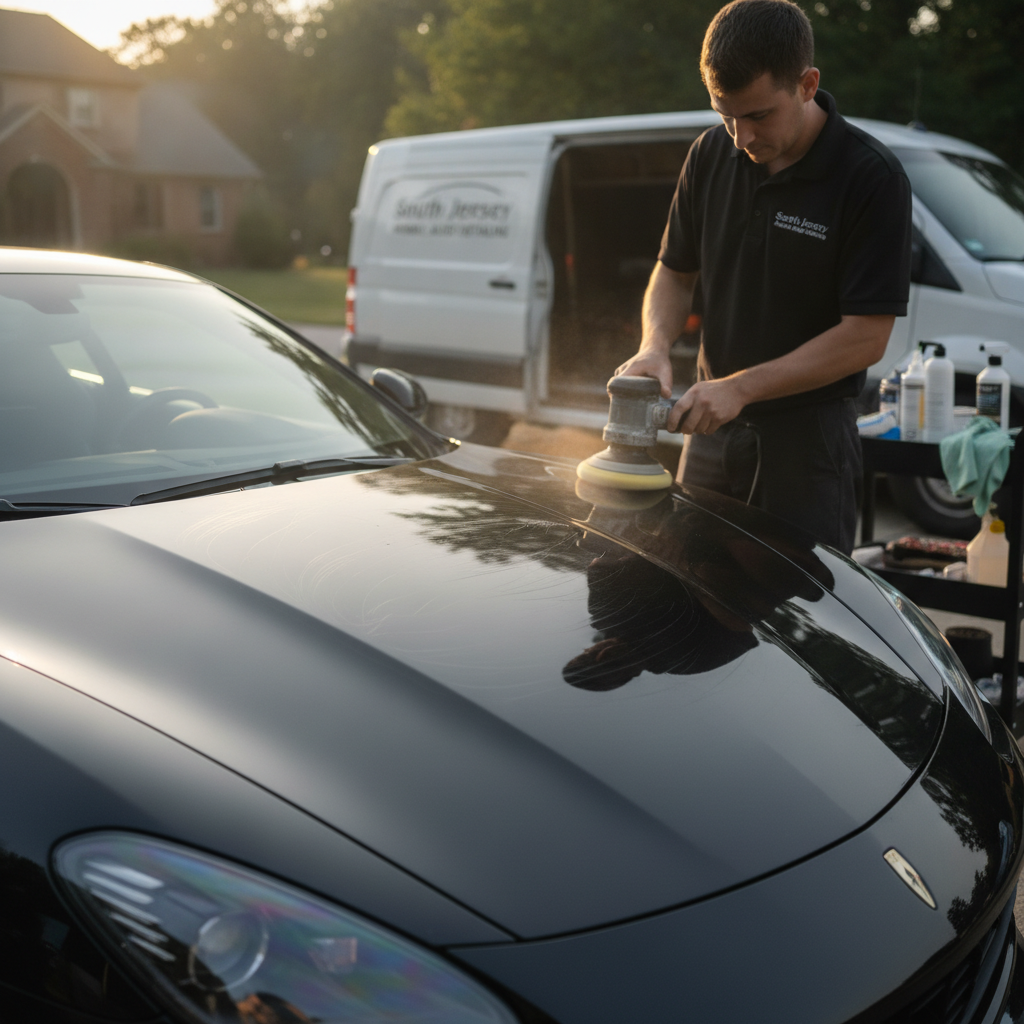
Professional swirl mark removal is a specific form of paint correction that uses machine polishing to level the surface of the clear coat and eliminate the micro-scratches causing the swirling effect. It’s not a wipe-down or a spray-on treatment — it’s a careful, multi-step process that requires training, proper equipment, and patience.
Here’s a simplified look at how the process typically works:
- Thorough wash and decontamination — The vehicle is washed carefully to remove all surface contamination. In many cases, a clay bar treatment follows to pull out bonded contaminants from the paint surface that a regular wash can’t lift.
- Paint inspection — A trained detailer examines the paint under bright lighting to assess the severity of the swirl marks and determine which polishing approach is needed. Not all paint is the same thickness or hardness, and the correction method must match.
- Machine polishing — A dual-action or rotary polisher is used with a specific combination of polishing compound and pad. The abrasive compound gently removes a thin, controlled layer of clear coat to flatten out the scratches and restore optical clarity.
- Final polish and inspection — After the heavier correction stage, a finer polish is applied to refine the finish and bring out maximum gloss. The panel is then inspected again under lighting to confirm the swirl marks have been eliminated.
- Protection application — Once the paint has been corrected, it should be protected immediately. Applying a wax, sealant, or ceramic coating locks in the results and helps prevent new swirl marks from forming as quickly.
Why This Is a Job for a Professional — Not a DIY Kit
You’ll find machine polishers and swirl-remover kits available online for under $100, and it’s tempting to try them at home. But here’s the honest reality: using a machine polisher incorrectly can cause more damage than the swirl marks you’re trying to fix. Applying too much pressure, using the wrong pad and compound combination, or working through the clear coat entirely creates paint burns or thin spots that can require expensive repairs.
Many generic national detailing chains also rush through the polishing stage or use a one-size-fits-all approach that doesn’t account for the specific paint type, condition, or color of your vehicle. A professional who takes time to properly inspect and assess your paint before touching it is what separates a genuinely corrected finish from a temporary cover-up.
What Competitors Don’t Tell You: The Link Between Swirl Marks and Coating Prep
One topic that’s consistently underexplored across most national detailing and coating websites is the direct relationship between swirl mark removal and protection service preparation. Many sites discuss paint correction and ceramic coating as separate services without clearly explaining why swirl mark removal must happen before coating application.
Here’s the critical detail: ceramic coatings and paint sealants are transparent. When applied over paint that still has swirl marks, they lock those imperfections in place — essentially sealing them under a hard, durable layer that makes them even harder to remove later. A coating applied over uneven, swirled paint will protect it, but it will protect the imperfections too.
This is why the correct sequence matters: correct the paint first, then protect it. If you’re considering a ceramic coating for your vehicle, ask specifically whether swirl mark inspection and removal is included in the prep work — or whether it’s an add-on service you need to request separately.
How Long Does Swirl Mark Removal Take and What Should You Expect?
The time required depends on the size of your vehicle and the severity of the paint defects. A single-stage polish on a lightly swirled vehicle might take three to four hours. A more thorough two-stage paint correction on a vehicle with significant swirling and additional scratches can take a full day or longer. Any service provider quoting under two hours for a full correction job on a mid-size or larger vehicle should raise a flag.
When evaluating services in the Blackwood area or surrounding communities like Berlin and Sicklerville, ask these questions upfront:
- Do you inspect the paint under lighting before quoting the service?
- What type of machine polisher do you use — dual-action or rotary?
- Do you use different compounds and pads for different paint conditions?
- Is decontamination included before polishing starts?
- What protection service do you recommend after correction?
These questions help you distinguish between a thorough professional process and a quick-turnaround polish that may not deliver lasting results.
Frequently Asked Questions About Swirl Mark Removal in South Jersey
Can swirl marks be removed from any color vehicle?
Yes, but swirl marks are most visible on dark colors like black, dark blue, and dark grey. Lighter colors tend to hide them better under normal lighting. Regardless of color, the correction process is the same — though the lighting inspection phase becomes especially important on darker paint.
Will swirl marks come back after removal?
They can, if the root causes aren’t addressed. After correction, switching to a proper two-bucket hand wash method, avoiding automated brush car washes, and applying a quality protective coating significantly slows their return. The cleaner and more protected your surface is, the longer your results will last.
Is swirl mark removal the same thing as paint correction?
Swirl mark removal is one specific outcome of paint correction. Paint correction is the broader term for using machine polishing to reduce or eliminate clear coat defects, which can include swirl marks, light scratches, water spot etching, and oxidation. Depending on your vehicle’s condition, a full paint correction may address several issues at once.
Do I need paint correction before getting a ceramic coating in Blackwood or nearby?
If your paint already has visible swirl marks or scratches, yes — correction before coating is strongly recommended. Applying a paint protection ceramic coating over uncorrected paint seals those defects in permanently until the coating is eventually removed. Starting with clean, corrected paint gives you the best long-term result.
How does South Jersey weather affect swirl marks?
South Jersey’s seasonal mix of road salt in winter, heavy pollen in spring, UV exposure in summer, and rain-driven contamination year-round all contribute to paint surface buildup that makes swirl-inducing washes more damaging. When you’re washing off salt and debris regularly during the colder months, proper wash technique and paint protection become more important than ever.
Ready to Restore Your Car’s Paint in Blackwood or the Surrounding Area?
If your vehicle’s finish looks dull, hazy, or shows circular scratches under sunlight, swirl mark removal could make a significant difference in how your car looks — and in its long-term value. At Flash Mobile Detailing, we provide professional paint correction services for car owners in Blackwood, Sicklerville, Gloucester Township, and throughout South Jersey, and we come directly to you.
Contact us today to schedule a consultation or request a quote. We’ll assess your vehicle’s paint condition honestly and recommend the right approach for your specific situation. Reach out through our contact page to get started.