
How Does Paint Decontamination Before Detailing Work and What Should Car Owners in Voorhees and South Jersey Know Before Their Next Service?
If you’ve ever had your car washed and waxed but noticed the paint still felt rough or looked dull shortly after, paint decontamination could be the missing step. For car owners in Voorhees and across South Jersey, understanding what decontamination is — and why it matters before any serious detailing or protective coating — can mean the difference between a finish that lasts and one that falls flat within weeks. Put simply, decontamination removes invisible bonded particles from your paint’s surface that a regular wash simply cannot lift. Without it, even high-quality products like ceramic coatings or polishes are working on a compromised foundation.
What Are Bonded Contaminants and Why Does Your Paint Have Them?
Every time you drive, your vehicle collects more than just visible dirt. Tiny particles of industrial fallout, brake dust, road tar, rail dust, and embedded grime bond directly to your paint’s clear coat over time. These particles are microscopic, but you can feel them — if you run a clean fingertip across a freshly washed panel and it still feels gritty or rough like sandpaper, that’s bonded contamination.
In South Jersey, driving conditions make this issue more pronounced than many car owners realize. Commuters traveling routes near industrial corridors in Camden County or along busy stretches through Gloucester Township and Blackwood pick up significant iron fallout from road traffic and brake dust. Winter months bring another layer of contamination: road salt residue that, if not fully addressed, continues to work into the surface even after the season ends. Tree sap and pollen — both common during spring and fall in neighborhoods throughout Washington Township and Voorhees — add organic contamination on top of that.
None of these are removed by a standard car wash, no matter how thorough. That’s why professional decontamination exists as its own distinct step in the detailing process.
The Two-Stage Decontamination Process Explained
A proper paint decontamination service typically involves two phases: a chemical stage and a mechanical stage. Understanding both helps you know what you’re paying for and what to expect.
Stage One: Chemical Decontamination
This step uses specially formulated sprays — most commonly an iron fallout remover and sometimes a tar and adhesive remover — applied to the paint after a thorough pre-wash. Iron removers work through a chemical reaction that dissolves embedded metallic particles. You’ll often see the product turn purple or red as it reacts with iron deposits on the surface — a clear sign the chemistry is doing its job. A tar remover follows for areas near the lower panels and wheel arches where petroleum-based road grime tends to accumulate heavily.
Stage Two: Clay Bar or Clay Mitt Treatment
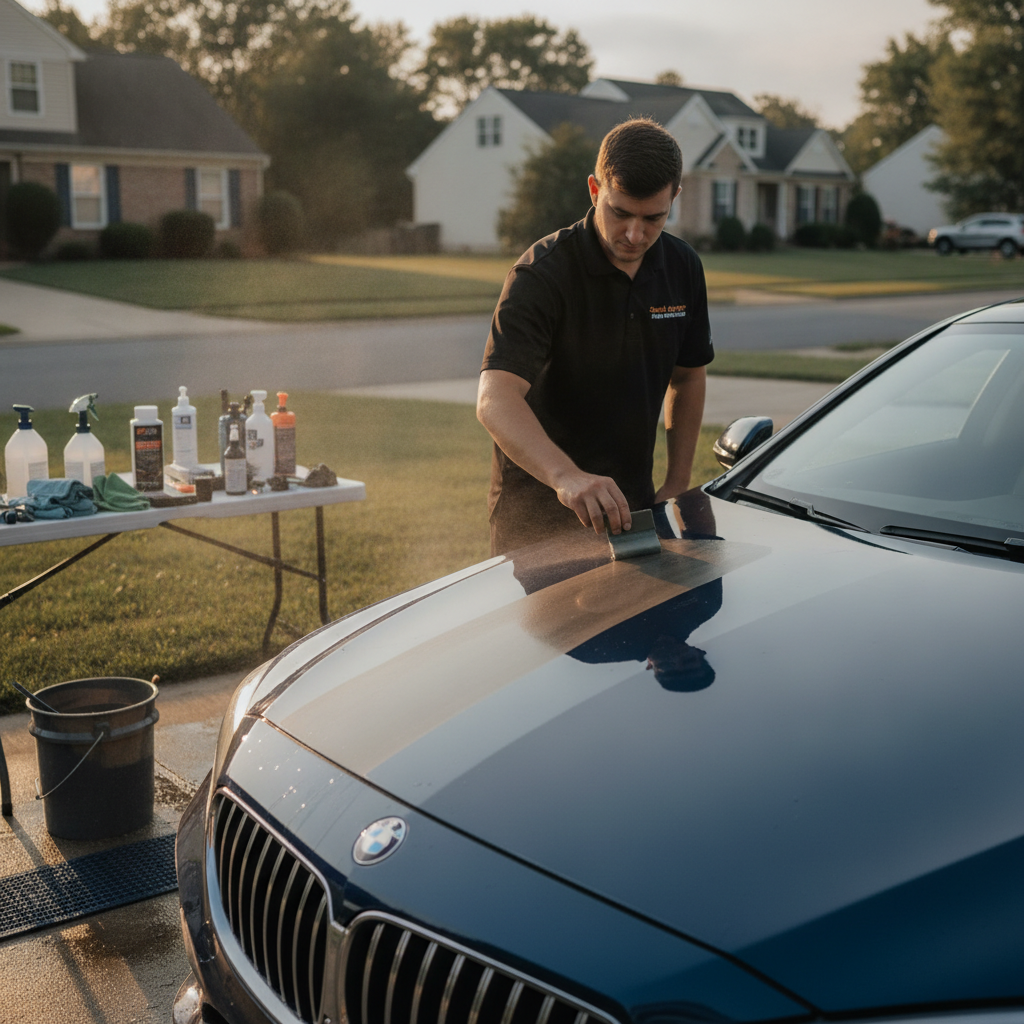
Once the chemical agents are rinsed away, the mechanical stage begins. A detailing clay bar or clay mitt is worked across the lubricated paint surface in gentle, overlapping passes. The clay picks up and physically lifts any remaining bonded particles that survived the chemical stage, leaving the surface smooth and properly prepared. After this step, the paint should feel noticeably slicker and glassier to the touch — a reliable sign that decontamination was thorough.
This two-stage approach is the professional standard, and it’s worth asking any detailer whether they perform both stages before moving on to polishing, paint correction, or coating application. A detailer who skips chemical decontamination and goes straight to clay — or skips both — is cutting a corner that could compromise the longevity of everything that follows.
Why Decontamination Matters Before Ceramic Coating
If you’re planning to have ceramic coating applied to your vehicle, decontamination is not optional — it’s essential. Ceramic coatings form a semi-permanent bond with your paint’s clear coat. If that surface still carries bonded contaminants when the coating is applied, those particles become sealed beneath the coating. Over time, this can cause the coating to fail prematurely, develop uneven protection, or create small blemishes that are difficult to address without fully removing the coating.
The same principle applies to paint correction. Polishing or compounding contaminated paint can grind particles across the surface, introducing fine scratches rather than removing them. Decontamination first, correction second, coating third — that’s the sequence a skilled detailer follows every time.
What the Big National Brands Often Miss on This Topic
Here’s a gap worth addressing directly: many of the larger national detailing brands and product-focused websites cover clay bar use in passing, usually as a brief entry in a product tutorial or FAQ. What they rarely explain is how chemical decontamination and clay bar treatment work together as a system, or why both stages matter specifically for drivers in environments like South Jersey where industrial fallout, seasonal road salt, and heavy commuting contamination are everyday realities.
Generic advice telling you to “clay your car once a year” ignores the fact that a daily driver in Voorhees or Cherry Hill accumulates fallout far faster than a lightly used weekend vehicle. The frequency and method of decontamination should match your actual driving habits and environment — not a one-size-fits-all recommendation written for a national audience.
How Often Should South Jersey Drivers Decontaminate Their Paint?
For most daily drivers in South Jersey, a full paint decontamination once or twice a year is a reasonable baseline. If your commute regularly takes you through heavy traffic corridors, or if your vehicle is parked outdoors year-round and exposed to pollen, tree sap, and road debris, erring toward two full decontamination sessions per year — ideally at the start of spring and in late fall before winter sets in — keeps your paint in the best possible condition.
Vehicles protected with ceramic coatings still benefit from periodic decontamination. While the coating dramatically reduces how much contamination bonds to the surface, iron fallout can still accumulate on the coating itself over time. An annual decontamination service helps maintain the coating’s performance and appearance between scheduled maintenance washes.
If you’re preparing your vehicle for sale, decontamination followed by a thorough mobile detailing service can meaningfully improve the way your paint looks and feels — a detail that buyers notice even if they can’t name exactly what’s different.
Frequently Asked Questions About Paint Decontamination in Voorhees and South Jersey
Can I do paint decontamination myself at home?
Consumer clay bars and iron removers are available, but using them incorrectly — with the wrong lubricant, too much pressure, or on paint that hasn’t been properly pre-washed — can create fine scratches. A professional has the products, technique, and experience to do it safely and effectively, especially before a coating application where the stakes are higher.
Will decontamination remove scratches or swirl marks from my paint?
No. Decontamination addresses bonded surface contamination, not physical paint defects like scratches or swirl marks. Those require paint correction — a separate polishing process. Decontamination is the necessary first step before correction can be done properly.
How long does a paint decontamination service take?
As a standalone step combined with a pre-wash, expect the decontamination phase to add roughly one to two hours to a full detail depending on the size of the vehicle and the level of contamination present. It’s typically included as part of a comprehensive exterior detailing package or ceramic coating prep service rather than performed in isolation.
Does decontamination damage paint or clear coat?
When performed correctly using appropriate products and technique, decontamination does not damage paint or clear coat. In fact, it removes particles that — if left in place — would cause far more damage over time, particularly during polishing or washing.
Is decontamination included in a standard car wash at a drive-through?
No. Automated car washes and even many hand washes do not include any form of paint decontamination. This step requires specific products and hands-on technique that only a professional detailing service provides.
Ready to Give Your Paint the Clean Slate It Deserves?
If your car’s paint feels rough after washing, you’re preparing for a ceramic coating, or you simply want to start fresh with a proper foundation, paint decontamination is the place to start. Flash Mobile Detailing serves Voorhees, Sicklerville, Cherry Hill, Gloucester Township, and the surrounding South Jersey area — coming directly to your home or workplace so the process is as convenient as possible for your schedule.
Reach out today through our contact page to ask questions or request a free consultation. We’re happy to walk you through exactly what your vehicle needs and put together a service plan that makes sense for how you drive and where you live.