
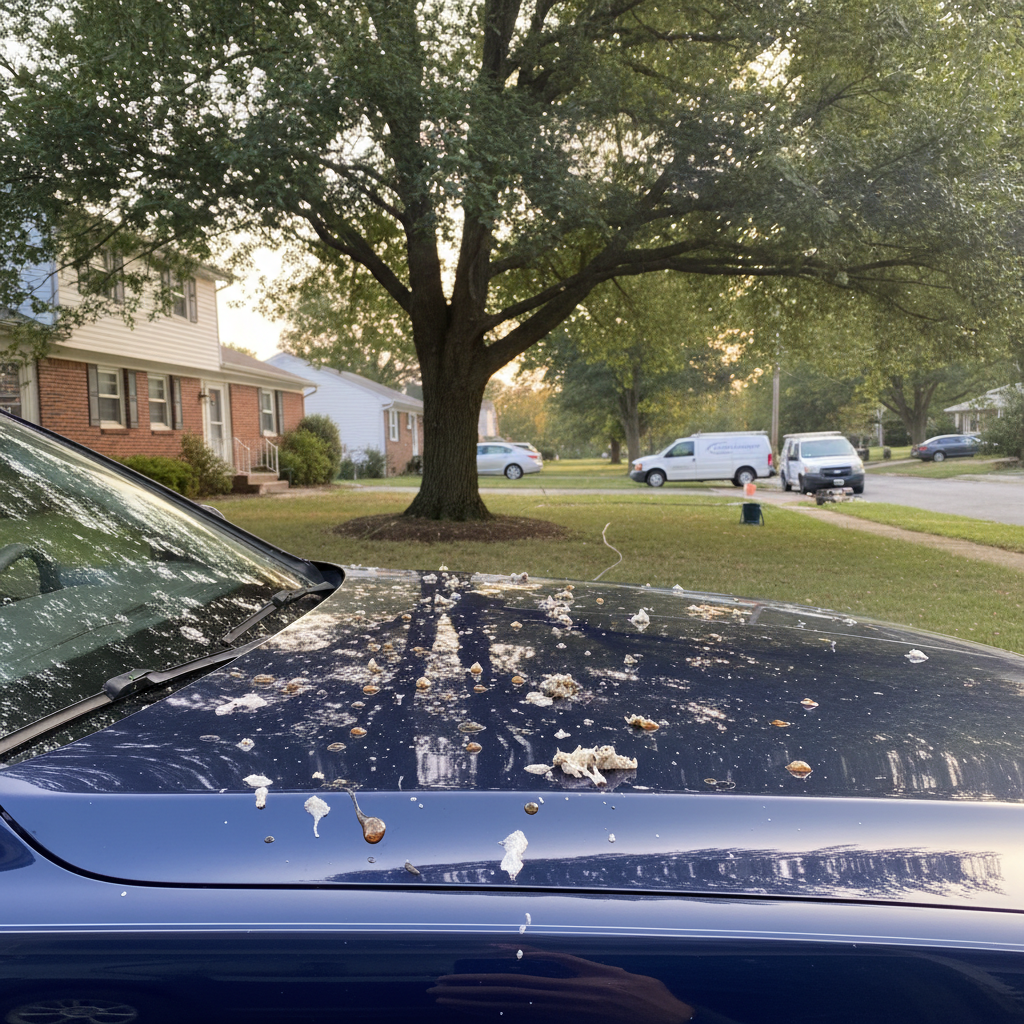
How Does Bird Droppings and Tree Sap Damage Your Car’s Paint in Berlin and What Can You Do About It?
If you park your car near trees in Berlin, Sicklerville, or anywhere across South Jersey, there’s a good chance you’ve come out to find your hood or roof decorated with bird droppings or a sticky patch of tree sap. Most drivers wipe it off and move on — but if that’s your habit, your car’s paint may already be suffering damage you haven’t noticed yet. Bird droppings and tree sap are two of the most chemically aggressive contaminants your vehicle’s finish encounters on a daily basis, and both can cause permanent etching in your clear coat if they’re not addressed quickly and correctly.
Why Bird Droppings Are More Damaging Than Most Drivers Realize
Bird droppings aren’t just unsightly — they’re acidic. The uric acid in bird waste has a pH low enough to begin breaking down your car’s clear coat within hours, especially during warm South Jersey summers when the sun heats up your vehicle’s surface and essentially bakes the droppings into the paint. The longer they sit, the deeper the damage goes.
What makes this particularly tricky is the texture. As bird droppings dry, they harden and bond to your clear coat. When you try to wipe them off dry, you risk grinding the crystallized material across your paint and creating fine scratches on top of any etching that’s already occurred. Even a wet cloth wiped too aggressively can leave marks. The right approach matters — and so does timing.
If you notice circular dull spots or faint impressions in your paint after removing droppings, that’s clear coat etching. At that stage, the damage has already been done, and paint correction may be needed to restore the surface before it worsens.
Tree Sap: The Slow-Moving Threat Hiding in Plain Sight
Tree sap is a problem that tends to sneak up on vehicle owners. It often starts as small, nearly invisible droplets — sometimes called honeydew — that land on your hood, roof, or trunk lid. Left untreated, sap hardens into a resinous crust that bonds stubbornly to your clear coat. Trying to remove hardened sap with household products like rubbing alcohol or acetone can strip wax, damage coatings, and leave dull spots behind.
Washington Township, Williamstown, and neighborhoods throughout Gloucester County have no shortage of mature trees lining driveways and parking areas. For residents who regularly park under oak, pine, or sweet gum trees — especially in spring and early summer — sap contamination is a recurring problem that compounds over time.
Like bird droppings, sap left on paint in direct sunlight can embed itself more deeply as heat softens the clear coat and allows the contaminant to penetrate. Warm months in South Jersey accelerate this process significantly.
The Gap Most Car Care Resources Miss: What to Actually Do After the Damage Appears
Most national car care websites and competitor resources stop at the basics — they’ll tell you to wash your car frequently or use a detail spray. What they rarely address is what happens when the damage has already started, or what the most practical and cost-effective path forward looks like for everyday drivers.
Here’s a practical breakdown of your options depending on the severity of the situation:
- Fresh droppings or sap (less than 24 hours old): A clean microfiber cloth dampened with a pH-neutral detail spray is usually enough to remove the contamination without scratching. Work gently from the outside in.
- Dried but no visible etching: A professional clay bar treatment during an exterior detail can lift bonded contaminants safely. This is a service worth scheduling at least once or twice a year, especially if you park outdoors regularly.
- Visible etching or dull spots: This typically requires paint correction — a machine polishing process that removes a microscopic layer of clear coat to level the surface and eliminate the damaged area. Paint correction should always be performed before applying any protective coating.
- Recurring contamination: If bird droppings or sap keep landing on your vehicle, a long-term protective layer like a ceramic coating creates a harder, more chemically resistant surface that makes future cleanup much easier and reduces the risk of etching.
Understanding which stage you’re at helps you make the right call rather than spending money on a solution that doesn’t match the problem.
How Ceramic Coating Helps Protect Against These Threats
One of the most practical long-term solutions for drivers who regularly deal with bird droppings or tree sap is applying a ceramic coating to their vehicle’s paint. Ceramic coatings bond to your clear coat and create a semi-permanent protective layer that is significantly harder and more chemically resistant than bare paint or traditional wax.
This doesn’t mean a coated car is immune to bird droppings or sap — no product eliminates the risk entirely — but it does mean those contaminants sit on top of the coating rather than bonding directly to your clear coat. That makes them far easier to remove safely, and it buys you more time before etching can occur. For busy commuters in Berlin, Gloucester Township, or anywhere across Camden County who don’t always have time to address contaminants the moment they appear, that extra margin can make a real difference.
It’s also worth noting that ceramic coatings require proper paint preparation before application. If your paint already has etching or swirl marks from past contamination, a paint correction step is typically performed first to ensure the coating bonds to a clean, smooth surface.
Why Mobile Detailing Makes This Easier to Stay On Top Of
One reason bird droppings and tree sap cause as much damage as they do is that most people simply don’t get around to addressing them quickly. Life gets busy — between work, the commute, and everything else, a few spots on the hood don’t feel urgent until the damage has set in.
That’s where mobile detailing changes the equation. Rather than waiting until you have a free afternoon to drive somewhere and drop your car off, a professional detailer can come to your home or workplace in Berlin, Sicklerville, or the surrounding area and handle everything on your schedule. Regular exterior detailing appointments — even once every few months — go a long way toward catching contamination before it causes lasting damage.
Frequently Asked Questions
How long does it take for bird droppings to damage car paint?
In warm weather, bird droppings can begin etching your clear coat within a few hours, especially if the car is sitting in direct sunlight. During cooler months the timeline is longer, but the damage still accumulates. The safest habit is to remove droppings as soon as you notice them.
Can I remove tree sap myself without damaging my paint?
It depends on how long the sap has been there. Fresh sap can often be removed with a detail spray and a soft microfiber cloth. Hardened sap requires a dedicated sap remover or professional clay bar treatment. Avoid using acetone, nail polish remover, or other harsh solvents — these can strip your clear coat or existing protective coatings.
Will a regular car wash remove bird droppings and tree sap?
A standard automatic car wash typically won’t remove dried bird droppings or bonded tree sap effectively, and the brushes used in many tunnel washes can actually grind those contaminants into your paint. Hand washing with the right products — or professional detailing — is a more reliable approach.
Does ceramic coating prevent bird dropping damage entirely?
Ceramic coating adds a layer of chemical resistance that makes your paint significantly more resistant to etching, but it doesn’t make your car invulnerable. Droppings still need to be removed in a reasonable timeframe. The coating gives you more time to act before etching occurs and makes cleanup much easier in the process.
How do I know if my clear coat has already been etched?
Etching typically appears as dull circular spots, faint impressions, or areas where the paint looks slightly sunken or lighter than the surrounding surface. These marks are visible in direct sunlight or under a bright light. If you suspect clear coat damage, a professional inspection can confirm whether paint correction is needed.
Protect Your Paint Before the Damage Adds Up
Bird droppings and tree sap may seem like minor annoyances, but over time they’re one of the more consistent sources of paint damage for vehicles in Berlin, Sicklerville, and across South Jersey. The good news is that with the right protective measures in place — and professional help when you need it — you don’t have to let these everyday hazards chip away at your car’s finish or its long-term value.
If you’re not sure where your paint stands or what level of protection makes sense for your vehicle, Flash Mobile Detailing is happy to take a look. We serve drivers throughout the South Jersey area and come directly to you — no need to rearrange your day. Reach out today to schedule a consultation and find out what your car actually needs.