
How Does Exterior Detailing Remove Contaminants From Your Car’s Paint in Berlin and What Should South Jersey Drivers Know About Clay Bar Treatment?
If you run your hand across your car’s paint after a fresh wash and it still feels rough or gritty — like sandpaper under your fingertips — your vehicle likely has embedded surface contaminants that a standard wash simply cannot remove. For drivers in Berlin and throughout South Jersey, this is a very common problem, and it often goes unaddressed for months or even years. Exterior detailing that includes a clay bar treatment is specifically designed to fix this. Here’s what the process involves, why it matters, and what you should expect when you have it done.
Why Your Car Feels Rough Even After Washing
A traditional car wash — even a thorough hand wash — only cleans the surface of your paint. What it cannot do is pull out contaminants that have actually embedded themselves into the clear coat. These particles bond to the paint surface over time and become nearly impossible to remove with soap and water alone.
In South Jersey, drivers face a specific combination of environmental factors that accelerate this problem. Industrial fallout from nearby highways and commercial areas deposits tiny metallic particles onto your paint. Road grime picked up on Route 73, the Atlantic City Expressway, and the Black Horse Pike gets baked onto the surface during warmer months. Tree sap and pollen — particularly during spring — stick to clear coat and attract additional debris. In winter, road salt residue can linger in the paint’s microscopic pores long after it appears washed away.
All of these contaminants, left untreated, contribute to a dull-looking finish, premature clear coat wear, and over time, paint damage that becomes significantly more expensive to correct.
What Is Clay Bar Treatment and How Does It Work?
Clay bar treatment is a professional decontamination process that uses a specially formulated detailing clay to physically lift and remove embedded particles from your paint surface. Think of it as a deep-cleaning step that sits between washing and polishing — one that addresses what washing misses and what polishing alone cannot fully resolve.
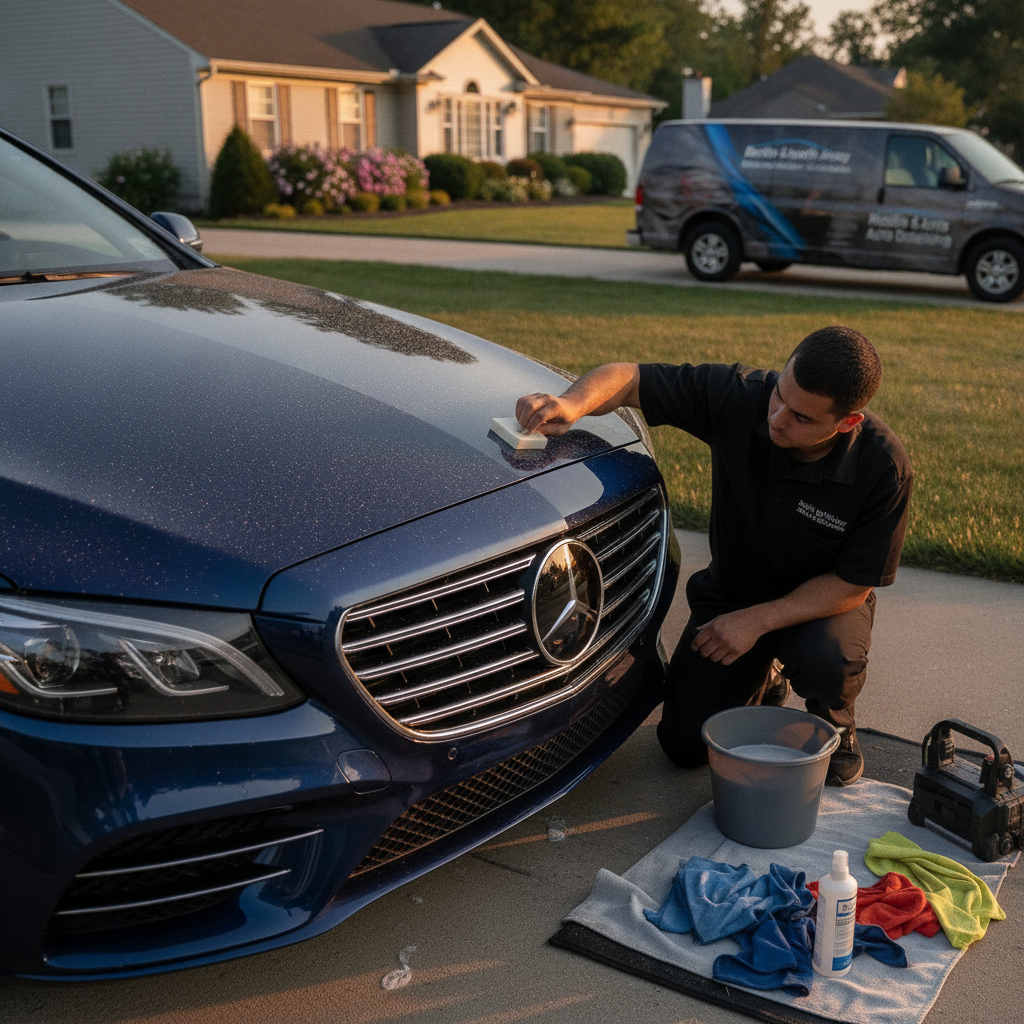
During the process, a detailer applies a clay lubricant to a section of the vehicle’s paint and then glides a clay bar across the surface. The clay grabs onto contaminants and pulls them free from the clear coat without scratching the paint. When done correctly, the difference is immediately noticeable — the surface becomes smooth, clean, and ready to receive protection like wax, sealant, or ceramic coating.
The clay bar treatment is not just for neglected vehicles. Even relatively new cars that have spent time on dealer lots or been driven through winter months in Camden County or Gloucester Township can accumulate enough contamination to warrant this step. If you’re planning to apply any kind of paint protection, skipping decontamination means that protection is being applied over a compromised surface — reducing both its appearance and its effectiveness.
The Full Exterior Detailing Process: What’s Actually Included
Clay bar treatment is one important step within a broader exterior detailing service. A complete exterior detail typically includes several stages designed to bring your paint back to a clean, protected state.
- Pre-wash and rinse: A foam or pre-soak product is applied to loosen heavy surface dirt before any contact is made with the paint.
- Hand wash: The vehicle is washed by hand using a two-bucket method to minimize the risk of introducing swirl marks or fine scratches.
- Wheel and tire cleaning: Brake dust and road grime are removed from wheels, with tire dressing applied for a clean finish.
- Clay bar decontamination: The clay bar step removes bonded contaminants and leaves the paint surface perfectly smooth.
- Paint inspection: The detailer inspects the surface for swirl marks, scratches, or oxidation that may require additional correction.
- Protection application: Depending on the package, a paint sealant, carnauba wax, or coating is applied to protect the freshly cleaned surface.
- Trim and glass care: Exterior trim is dressed to prevent fading, and glass is cleaned for clear visibility.
This is the level of thoroughness that separates professional exterior detailing from an automatic car wash or a quick hand rinse at home. For daily commuters in Williamstown or Winslow Township who put significant miles on their vehicles, this kind of care makes a meaningful difference in how the paint holds up year to year.
The Content Gap Most Detailing Sites Miss: When to Schedule Decontamination and How Often
Most national detailing resources and competitor sites touch briefly on what clay bar treatment is — but very few actually tell you when to do it or how to fit it into a realistic maintenance schedule. This is one of the most common questions local drivers ask, and it deserves a straightforward answer.
For drivers in the Berlin and Sicklerville area who commute regularly and deal with South Jersey’s seasonal conditions, a good general guideline is to schedule a full exterior detail with decontamination at least once or twice per year. The best timing points are at the end of winter — to remove road salt residue and grime buildup — and again in late summer or early fall, when UV exposure, tree sap, and insect residue have done their damage throughout the warm months.
If you’re planning to apply or refresh a paint protection ceramic coating, decontamination is a required step beforehand, not optional. Applying a coating over contaminated paint traps those particles beneath the coating and can lead to uneven bonding, reduced gloss, and diminished protection over time.
Vehicles that spend a lot of time parked outdoors — under trees, in open lots, or near construction areas — may need decontamination more frequently. A professional detailer can assess your paint during a consultation and give you a realistic recommendation based on what they actually observe.
Why Mobile Detailing Makes This Easier for South Jersey Drivers
One of the most practical advantages of working with a mobile detailing service is that the service comes to you. For busy commuters and families in Gloucester Township, Berlin, or nearby neighborhoods, finding time to drop a vehicle off at a fixed location and wait for it isn’t always realistic. A mobile detailer brings all the equipment needed for a full exterior detail — including clay bar decontamination — directly to your driveway or parking area.
This removes the scheduling barrier that causes many drivers to put off detailing far longer than they should. And because paint contamination compounds over time, earlier intervention typically means less correction work and better long-term results for your vehicle’s finish.
Frequently Asked Questions
How do I know if my car needs a clay bar treatment?
Run a clean, dry hand across your freshly washed paint. If the surface feels rough or textured instead of smooth and slick, your paint has bonded contaminants that need to be removed. A visual inspection for dullness or a hazy appearance is another sign.
Is clay bar treatment safe for all paint types?
Yes, when done correctly with proper lubrication by a trained detailer, clay bar treatment is safe for factory paint, single-stage paint, and clear-coated finishes. It should always be performed with adequate lubricant to avoid any surface marring.
How long does a full exterior detail take?
A thorough exterior detail including clay bar decontamination typically takes between two and four hours depending on the vehicle’s size and the level of contamination. Larger vehicles like SUVs and trucks generally take longer than sedans or coupes.
Can I apply wax or ceramic coating without clay bar treatment first?
You can, but it’s not recommended. Applying a protective layer over contaminated paint traps debris beneath it, reducing the coating’s ability to bond properly and diminishing both its appearance and its durability. Decontamination should always precede protection.
How often should Berlin and South Jersey drivers schedule exterior detailing?
For most drivers in the area, once or twice a year is a practical baseline. Scheduling a full exterior detail in spring — after road salt season — and again in the fall before winter sets in is a solid routine. Vehicles exposed to heavier environmental stress may benefit from more frequent attention.
Ready to Get Your Car’s Paint Truly Clean?
If your vehicle’s paint has been through a South Jersey winter, spring pollen season, or months of highway commuting, it likely has more embedded contamination than you realize. A professional exterior detail with clay bar treatment is one of the most effective ways to restore the feel and appearance of your paint — and to prepare it for any protection service you’re considering.
Flash Mobile Detailing serves Berlin, Sicklerville, Williamstown, Gloucester Township, and surrounding communities across South Jersey. The service comes to you, so there’s no need to rearrange your schedule or drop your vehicle off anywhere. Reach out today to schedule your exterior detail or ask any questions about the process.