
What Is Paint Overspray and How Can Car Owners in Winslow Township Remove It Without Damaging Their Vehicle?
If you have ever noticed a rough, gritty, or hazy texture on your car’s paint after driving near a construction zone, a freshly painted building, or a road resurfacing project, there is a good chance you are dealing with paint overspray. For drivers in Winslow Township and surrounding communities across South Jersey, this is more common than most people realize — and it is one of those problems that tends to get worse the longer you wait. The good news is that with the right professional approach, overspray can be removed safely without harming your vehicle’s finish.
What Exactly Is Paint Overspray?
Paint overspray happens when airborne paint particles drift beyond their intended surface and land on your vehicle. This can come from a number of sources: road painting crews marking lane lines, nearby construction sites applying primer or sealant to structures, commercial painting operations, or even freshly painted parking lot curbs. The particles settle onto your clear coat and bond to the surface as they dry, leaving behind a texture that can feel like fine sandpaper when you run your hand across the panel.
Unlike bird droppings or tree sap — which sit on top of your paint — overspray can partially embed into the clear coat depending on how long it has been sitting and how much heat or sunlight it has been exposed to. That is what makes it tricky to deal with and why the removal process requires a careful, experienced hand.
Why Paint Overspray Is a Bigger Problem in South Jersey Than You Might Think
South Jersey has seen significant road construction and commercial development activity in recent years, especially along heavily traveled corridors through areas like Winslow Township, Gloucester Township, and Williamstown. If you commute regularly or spend time near active work zones, your vehicle has almost certainly been exposed to some level of airborne contamination — even if you have not noticed it yet.
On top of that, South Jersey’s climate adds another layer of risk. UV exposure during warm months can cause overspray particles to bake into the clear coat faster. Once that happens, removal becomes more involved and requires more aggressive correction techniques to restore the surface properly.
What Happens If You Try to Remove Overspray Yourself?
This is where a lot of well-meaning car owners end up making things worse. A quick search online will surface all kinds of DIY suggestions — razor blades, lacquer thinner, acetone, rubbing compound — and while some of these may appear to work on the surface, they often cause more damage than the overspray itself.
- Razor blades can leave fine scratches in the clear coat that are difficult and expensive to correct later.
- Solvents like acetone or lacquer thinner can strip your clear coat entirely if used incorrectly, leaving dull or uneven patches.
- Aggressive rubbing compounds applied without proper technique can cut through the clear coat on thinner panels like hoods and rooftops.
The safest path forward — especially if the overspray has had time to dry — is to bring in a professional detailer who has the right tools and the experience to assess the severity before touching the paint.
How a Professional Detailer Removes Paint Overspray
Professional overspray removal typically follows a multi-step process, and the specific approach depends on how deep the contamination has bonded to the surface.
Step 1: Visual and Tactile Assessment
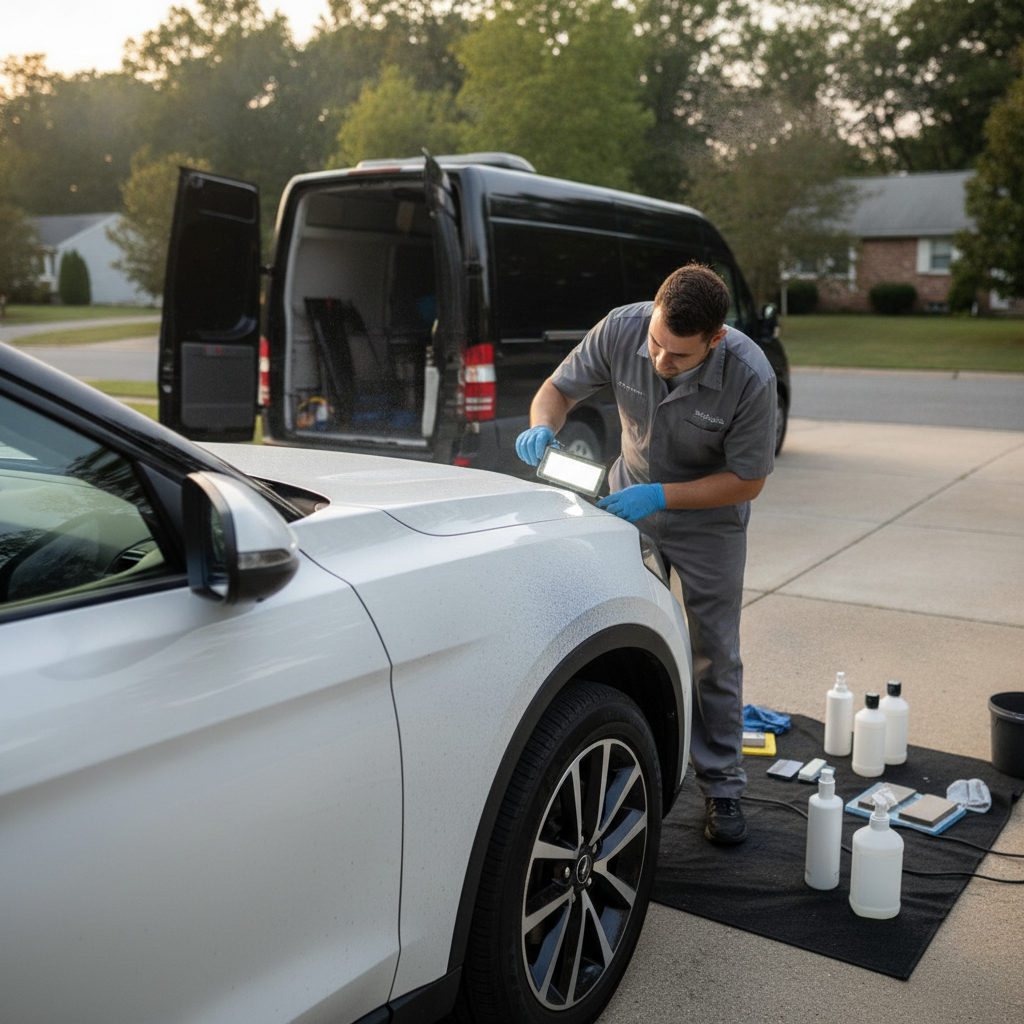
Before anything touches your paint, a professional will inspect the affected panels in good lighting and run a clean hand across the surface to gauge the severity. Fresh, light overspray behaves differently from older, heat-set contamination, and the removal method should reflect that difference.
Step 2: Clay Bar or Specialty Overspray Removal Cloth
For lighter cases, a detailing clay bar can lift overspray particles off the clear coat without abrasion. This is the gentlest approach and works well when the contamination has not fully bonded. In some cases, professional detailers will use a specialty overspray removal cloth designed specifically for this type of contamination.
Step 3: Light Paint Correction if Needed
If the overspray has etched into or scuffed the clear coat during the removal process, a light machine polish can restore clarity and gloss. This step is not always necessary, but it is an important safety net for ensuring the finish looks right when the job is done.
Step 4: Protection
Once the surface is clean and corrected, applying a protective layer makes a significant difference in how your paint holds up to future contamination. A ceramic coating is one of the most effective long-term options — it creates a semi-permanent hydrophobic layer over your clear coat that makes it much harder for contaminants like overspray, pollen, and road grime to bond in the first place.
What Competitor Sites Are Not Telling You About Overspray
If you have done any research on this topic, you may have noticed that most major detailing brands and national chains barely address paint overspray at all. When they do, the content is generic — it mentions clay bars and leaves it at that. What they consistently miss is the importance of the assessment phase and the risk of using the wrong removal method based on how long the overspray has been sitting.
They also rarely address what to do after removal. Cleaning the surface is only half the job. Without applying some form of paint protection afterward, you are leaving freshly corrected paint exposed to the same environmental hazards that caused the problem in the first place. This is especially relevant in areas like Berlin and Sicklerville, where active road work and seasonal weather create ongoing contamination risks throughout the year.
A local professional who works on vehicles in your area every day understands these regional factors in a way that a generic national resource simply cannot replicate. If you want to see the kind of work that comes out of a thorough correction and protection process, the Flash Mobile Detailing gallery is worth a look.
How to Prevent Overspray Damage in the Future
You cannot always avoid driving near construction zones, but you can take steps to make your vehicle more resilient to the contamination that comes with it.
- If you notice you have driven through an active road painting zone, rinse your vehicle as soon as possible — fresh overspray is far easier to remove than dried overspray.
- A ceramic coating or paint protection layer gives your clear coat a fighting chance when airborne particles land on it, since they bond to the coating rather than the paint itself.
- Regular exterior detailing helps catch surface contamination before it has time to set in deeply.
- Avoid parking near active construction or commercial painting operations when you have the option.
Frequently Asked Questions About Paint Overspray in South Jersey
How do I know if what is on my car is actually overspray and not something else?
Overspray typically feels rough or gritty across a large section of a panel rather than appearing as a single spot. If you run a clean fingertip across the paint and it feels like fine sandpaper in an area where the paint looks otherwise normal, overspray is a likely cause. A professional detailer can confirm this during a visual inspection.
Can overspray permanently damage my car’s paint?
If left untreated for an extended period — especially through hot summer months in South Jersey — overspray can bond tightly enough to the clear coat that removal becomes much more involved. In severe cases, it may require more aggressive paint correction to restore the surface. Early treatment is always easier and less costly.
Is overspray removal covered by my car insurance?
In some cases, yes — particularly if the overspray came from a third-party source like a road crew or a neighboring business. It is worth contacting your insurance provider and documenting where and when the contamination occurred. A professional detailer can also provide a written estimate that you can submit as part of a claim.
How long does overspray removal take?
The timeline depends on how much of the vehicle is affected and how deeply the particles have bonded. A moderate case on one or two panels might take a couple of hours. A more widespread or severe case involving multiple panels and follow-up correction work could take longer. A mobile detailer can assess your situation and give you a realistic timeframe before work begins.
Do I need ceramic coating after overspray removal?
You do not have to get ceramic coating, but it is worth considering — especially if your vehicle is regularly exposed to construction zones or road work in areas like Winslow Township or Gloucester Township. A protective coating applied after a thorough decontamination gives your paint a much stronger barrier against future contamination and makes your next cleaning significantly easier.
Ready to Get Overspray Removed the Right Way?
Paint overspray is one of those problems that does not fix itself and tends to become more difficult to address the longer it sits. If your vehicle has picked up overspray from a road crew, construction site, or nearby painting project anywhere in South Jersey, the team at Flash Mobile Detailing can assess the situation and recommend the right approach — without risking further damage to your paint.
We come to you, which means there is no need to schedule time off or drive across town. Whether you are in Winslow Township, Sicklerville, Williamstown, or anywhere else in the area, we make professional paint care as convenient as possible. Reach out today to schedule a consultation and let us take a look at what you are working with.