
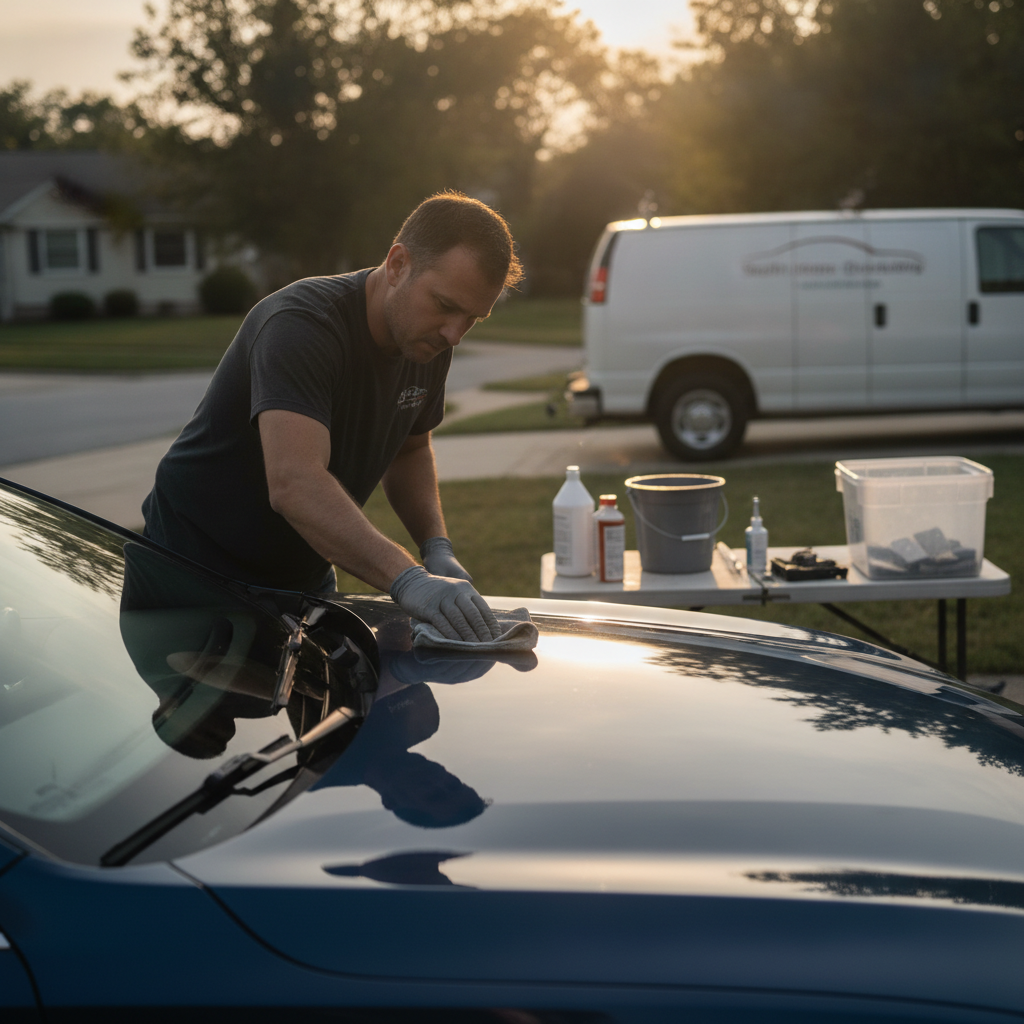
How Does a Clay Bar Treatment Restore Contaminated Paint on Vehicles in Sicklerville and South Jersey?
If your car’s paint feels rough and gritty even after a thorough wash, a clay bar treatment is likely the step your vehicle has been missing. In Sicklerville and throughout South Jersey, vehicles deal with a steady accumulation of airborne contaminants — brake dust, industrial fallout, road grime, and environmental pollution — that bond directly to your clear coat and can’t be removed with soap and water alone. A clay bar treatment physically lifts those embedded particles off the paint surface, leaving it smooth, clean, and genuinely ready to be protected. It’s one of the most effective but least talked-about steps in professional detailing, and it makes a noticeable difference you can actually feel with your fingertips.
What Exactly Is a Clay Bar and How Does It Work?
A detailing clay bar is a specially formulated, pliable compound that glides across a lubricated paint surface and mechanically pulls out contaminants that are bonded to or embedded in your clear coat. Think of it like a lint roller for your paint — but far more effective. As the clay bar passes over the surface, it picks up everything that washing left behind: industrial fallout, rail dust, tree sap residue, pollen compounds, and fine particles from road debris.
The process itself is straightforward. The surface is first thoroughly washed and rinsed. A clay lubricant is then sprayed onto a small section of the panel. The clay bar is gently worked back and forth across that lubricated area in overlapping passes. As it moves, you’ll often feel it catching and dragging at first — that’s the clay grabbing the contaminants. As the section becomes decontaminated, the clay glides more freely and the panel feels noticeably smoother. The clay is folded to a clean section as it picks up debris, and the process continues across the entire vehicle.
When done correctly by a trained professional, clay bar treatment causes no damage to your paint. In fact, it’s one of the safest and most beneficial paint prep steps available.
Why South Jersey Driving Conditions Make Decontamination Especially Important
Vehicles in Sicklerville, Winslow Township, and the broader South Jersey region face a particularly challenging environment for paint health. During winter months, road salt used on local highways and side streets doesn’t just threaten your undercarriage — it also coats your paint panels with a fine, corrosive film that lingers long after the roads dry. In spring, heavy pollen from the trees throughout Gloucester County and Camden County settles into every surface. Summer brings UV exposure and road tar from hot asphalt. Fall adds organic debris, moisture, and early frost.
If you’re commuting daily on routes through Williamstown, Berlin, or Deptford, your vehicle is picking up brake dust, exhaust particles, and highway grime continuously. Many of these particles are ferrous — meaning they contain tiny iron fragments from brake pads and rotors — and they actually oxidize into your clear coat over time if left untreated. That’s what causes the rough, sandpaper-like texture many vehicle owners notice and incorrectly assume is just a paint quality issue.
A clay bar treatment is the correct and effective solution for exactly this kind of surface contamination.
What Many Competitors Overlook: Clay Bar as a Stand-Alone Service
Here’s something worth knowing: most detailing content online — including material from well-known national brands — treats clay bar treatment as little more than a bullet point in a longer prep checklist. It’s almost always mentioned in the context of preparing for ceramic coating or paint correction, but rarely discussed as a valuable stand-alone service that benefits everyday vehicle owners.
That’s a gap worth addressing. You don’t need to be planning a full ceramic coating application to benefit from paint decontamination. If your vehicle hasn’t had a clay bar treatment in the past year or two — or ever — the paint surface likely has a significant build-up of bonded contaminants. A professional clay bar service on its own can restore a smooth, clean surface, improve the way your vehicle’s paint looks in direct sunlight, and make any wax or sealant you apply afterward bond far more effectively.
At Flash Mobile Detailing, clay bar treatment is part of a thorough exterior detailing process and can also be performed as a dedicated decontamination step before protection services are applied.
Clay Bar Treatment as Prep for Ceramic Coating
If you are planning to have a ceramic coating applied to your vehicle, paint decontamination is not optional — it’s essential. Ceramic coatings bond directly to your clear coat, and any contaminants left on the surface will be sealed in permanently. That means a rough, contaminated surface will remain rough and contaminated under the coating, no matter how good the product is.
Proper prep always includes a thorough wash, a clay bar decontamination step, and — depending on the condition of the paint — a paint correction to address swirl marks, light scratches, or oxidation before the coating goes on. Skipping decontamination is one of the most common reasons ceramic coatings underperform or fail to bond correctly.
If you’re considering ceramic coating for your vehicle, ask any detailer you speak with whether their process includes a dedicated decontamination step. The answer tells you a lot about the quality of workmanship you can expect.
What to Expect During a Professional Clay Bar Service in Washington Township or Surrounding Areas
When you book a professional exterior detailing service that includes paint decontamination, here’s a general sense of what the process looks like:
- Pre-wash and rinse: The vehicle is washed thoroughly to remove loose dirt, dust, and surface debris before the clay bar is used.
- Panel-by-panel decontamination: A technician works systematically across each panel, applying lubricant and working the clay bar in careful, controlled passes.
- Clay inspection and folding: The clay is folded regularly to expose a clean surface. A heavily contaminated vehicle may go through more clay material than a lightly contaminated one.
- Post-clay wipe-down: After each section, residual lubricant is wiped away, and the surface is inspected.
- Follow-up protection: Decontaminated paint is an ideal surface for wax, sealant, or ceramic coating. Most professional services will recommend applying a protective layer after clay treatment to lock in the results.
For a typical mid-size vehicle, a thorough clay bar treatment combined with a wash generally takes one to two hours depending on the level of contamination. For larger vehicles or heavily neglected paint, expect the process to take longer.
Frequently Asked Questions About Clay Bar Treatment in Sicklerville and South Jersey
How do I know if my car needs a clay bar treatment?
Run a clean plastic bag over a freshly washed and dried panel on your vehicle. If the surface feels bumpy or rough rather than glassy smooth, you have embedded contamination. Most vehicles driven regularly in South Jersey will benefit from a clay treatment at least once a year.
Is clay bar treatment safe for all paint types?
Yes, when performed correctly with proper lubrication and appropriate clay grade, the process is safe for modern automotive paint, including factory and professionally applied finishes. An experienced detailer will select the right clay grade for your vehicle’s paint condition.
Can I clay bar my car myself at home?
DIY clay bar kits are available at auto parts stores, but using them incorrectly — without enough lubrication, or with a clay bar that has dropped on the ground — can cause scratches. A professional detailer has the training and proper materials to do this safely and effectively, and the results are typically far more thorough.
How often should a vehicle in South Jersey be clay bar treated?
For most daily drivers in Sicklerville and surrounding areas, once or twice a year is a reasonable guideline. Vehicles that spend significant time on highways, near industrial areas, or in heavy seasonal weather may benefit from more frequent treatment.
Does clay bar treatment remove scratches?
No — clay bar treatment removes surface contaminants but does not correct scratches, swirl marks, or paint defects. If your paint has visible scratches or oxidation in addition to contamination, paint correction may be recommended before any protective service is applied.
Ready to Get Your Paint Feeling Like New Again?
If your vehicle’s paint has lost its smooth, glassy feel, or if you’re preparing for a ceramic coating and want to make sure the prep is done right, Flash Mobile Detailing is ready to help. Serving Sicklerville and the surrounding South Jersey communities — including Washington Township, Deptford, Williamstown, and beyond — we bring professional-grade detailing services directly to your location, so you don’t have to rearrange your day around a shop appointment.
Reach out through our contact page to ask questions, describe your vehicle’s condition, or request a consultation. We’ll help you figure out the right services for your car and your schedule.