
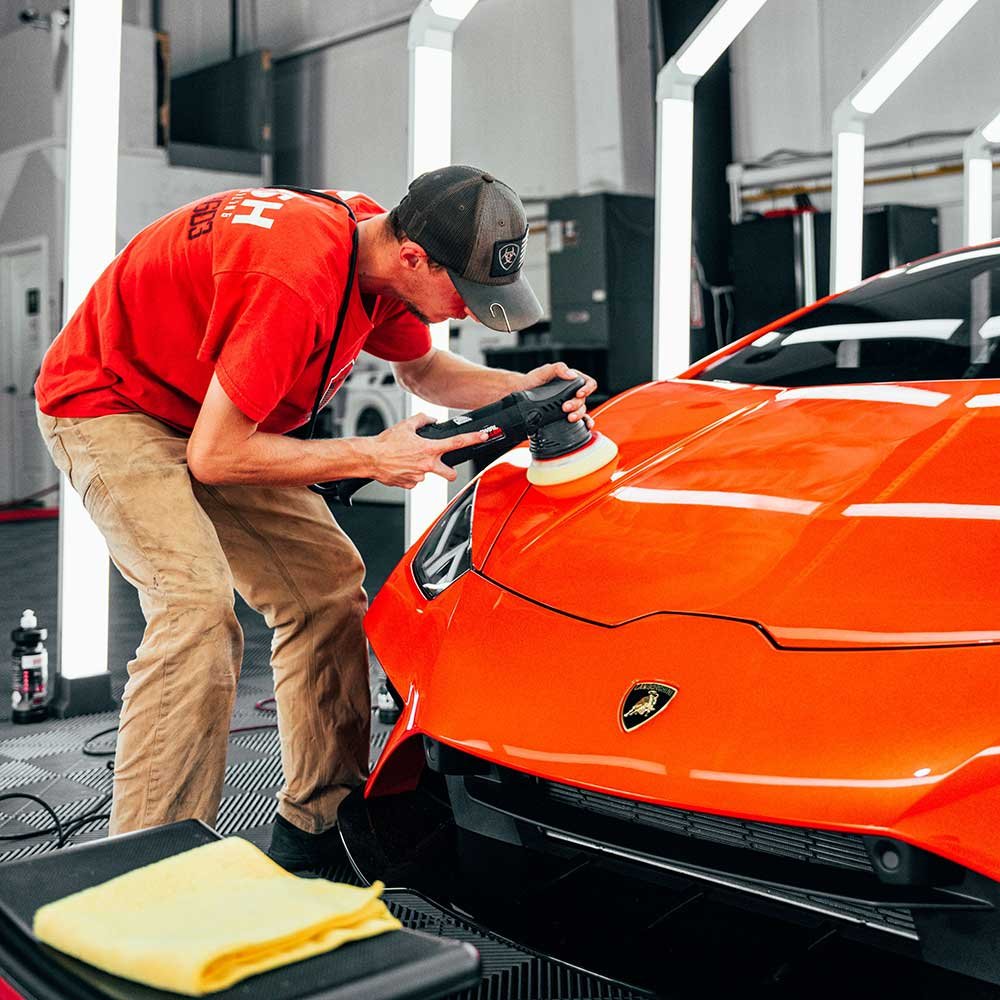

Ceramic Coating is a thin, durable surface treatment that can make vehicle paint look glossier, shed water more easily, and resist many everyday contaminants. It is not armor for your clear coat, though. It will not stop rock chips, deep scratches, or damage caused by improper washing.
For drivers who want easier maintenance and long-term appearance protection, the value comes down to preparation, realistic expectations, vehicle use, and maintenance habits. We recommend looking beyond dramatic water beading and focusing on the complete protection plan for your vehicle.
Ceramic coating works best as a maintenance and appearance-protection upgrade, not as impact protection.
Key Takeaways
• Ceramic coating cures into a very thin protective film over properly prepared exterior surfaces.
• It improves gloss, water behavior, and resistance to common contaminants such as road film, tree sap, bird droppings, and UV exposure.
• It does not make paint scratch-proof or prevent rock chips. Paint Protection Film is the stronger choice where impact resistance matters.
• Surface preparation often has more influence on the finished appearance than the coating brand itself.
• Many consumer coatings may provide practical performance for roughly one to three years, depending on exposure, washing methods, and maintenance.
• A professional installation can be worth considering when paint correction, controlled curing conditions, and consistent application matter.
Table of Contents
- What Ceramic Coating Is and How It Works
- What Ceramic Coating Protects Against
- Ceramic Coating Compared With Wax, Sealants, and PPF
- Preparation, Application, and Curing
- Maintenance and Common Failure Modes
- Choosing Ceramic Coating for Your Vehicle
- Ceramic Coating FAQ
- Final Thoughts
- Sources and References
What Ceramic Coating Is and How It Works
A thin, crosslinked protective film
Ceramic coating is commonly a silica-based liquid coating, often associated with SiO2 chemistry, that cures into a thin film on the vehicle’s surface. Depending on the product formulation, the liquid uses chemical reactions similar to sol-gel processes to form a more stable, crosslinked layer after application and curing.
Think of it as a highly refined protective skin over the clear coat. It is much thinner than Paint Protection Film and cannot absorb a direct stone impact, but it can reduce how strongly dirt, oily road film, and contaminants cling to the surface.
The coating does not repair paint. If swirl marks, haze, water-spot etching, or scratches remain before application, the coating can make those defects more noticeable by increasing gloss. That is why paint correction is often performed before a long-term coating is installed.
Hydrophobic behavior is useful, but not the whole story
A ceramic-coated surface is often described as hydrophobic, meaning it tends to repel water. This creates water beading or sheeting, which can make washing and drying easier. Still, water beading alone is not a complete measure of coating health.
| Performance measure | What it indicates | Why it matters |
|---|---|---|
| Contact angle | How rounded a water droplet appears on the surface | Higher angles can indicate stronger water repellency |
| Sliding angle | How easily water moves off when the panel is tilted | Lower angles can mean water sheds more readily |
| Chemical resistance | Ability to withstand certain cleaners and contaminants | Helps preserve the coating during regular maintenance |
| Abrasion retention | How well performance survives washing and environmental wear | More relevant than a single dramatic water-beading test |
| Surface slickness | How smoothly contaminants release during washing | Can improve cleaning feel, but may decline before protection fully fails |
For example, a hood may stop producing tight beads after repeated exposure to mineral-rich water. That does not automatically mean the coating is gone. Road film, mineral deposits, or residue from wash products can mask hydrophobic behavior until the surface is properly cleaned.
Ceramic coating is not the same as a factory coating
Some vehicles leave the factory with paint treatments, clear-coat technologies, or ceramic-like surface systems. Those should not automatically be treated as equivalent to an aftermarket detailing coating.
An aftermarket Ceramic Coating is a separately applied product installed after paint evaluation and preparation. It may also be formulated differently depending on whether it is intended for paint, PPF, glass, trim, wheels, or matte finishes. Compatibility matters, particularly on satin paint, matte PPF, and textured trim where unwanted gloss or streaking can be difficult to correct.
What Ceramic Coating Protects Against
The practical benefits for daily-driven vehicles
Ceramic coating can reduce the effort required to keep a vehicle clean. On a regularly maintained car, grime may rinse away more easily and drying can be faster because water does not spread and cling in the same way.
Common benefits include:
• Improved gloss enhancement and visual depth
• Better resistance to UV-driven fading and oxidation over time
• Less adhesion from road grime, pollen, bug residue, and light organic contamination
• Easier washing and drying when proper wash methods are used
• Added chemical resistance against many routine environmental contaminants
• Protection for more than paint, including suitable wheels, trim, headlights, and glass products
Owner discussions often reflect this practical benefit: ceramic coatings can make cleaning feel easier, but they do not eliminate washing or maintenance. This owner discussion about cleaning and maintenance expectations illustrates why convenience, not zero upkeep, is the realistic goal.
What ceramic coating cannot prevent
Fair warning: a Ceramic Coating should never be sold as a substitute for careful driving, safe washing, or impact protection.
| Threat | Does ceramic coating help? | Better protection strategy |
|---|---|---|
| UV exposure and oxidation | Yes, to a degree | Coating plus regular washing and covered parking when possible |
| Bird droppings and tree sap | Helps with cleanup if removed promptly | Wash contaminants off quickly |
| Fine wash marring | Limited help only | Proper wash tools and technique |
| Rock chips | No | Paint Protection Film on high-impact areas |
| Deep scratches | No | Repair or paint correction when appropriate |
| Door dings | No | Careful parking and paintless dent repair if needed |
| Mineral-water spots | Limited help | Prompt drying and periodic decontamination |
A coating may add some surface durability, but improper wash media, dirty towels, and aggressive brushing can still create swirl marks. For a daily driver, the wash process often determines whether the finish stays sharp after coating.
Which surfaces benefit most
Different exterior materials face different threats, so the best coating approach is not always one product for every panel.
| Surface | Main benefit | Important limitation |
|---|---|---|
| Painted panels | Gloss, easier cleaning, chemical resistance | Does not stop chips or deep scratches |
| Wheels | Brake-dust cleanup can be easier | Requires heat-appropriate product and regular cleaning |
| Glass | Improved water shedding in rain | Wiper wear and abrasion can shorten performance |
| Plastic trim | Can improve appearance and reduce grime adhesion | Product compatibility is essential to avoid streaking |
| Headlights | Easier cleaning and supplemental UV resistance | Cannot reverse existing oxidation |
| PPF | Can improve slickness and maintenance | Use a coating approved for film surfaces |
| Matte finishes | Can aid cleaning without adding shine when compatible | Incorrect products can change the finish appearance |
Ceramic Coating Compared With Wax, Sealants, and PPF
Choose protection based on the threat you want to solve
Wax, synthetic sealants, ceramic sprays, true ceramic coatings, and Paint Protection Film each have different roles. The right choice depends on whether you want short-term gloss, easier maintenance, long-term chemical resistance, or physical impact protection.
| Option | Primary purpose | Typical durability expectation | Prep burden | Best fit |
|---|---|---|---|---|
| Carnauba wax | Warm gloss and sacrificial protection | Weeks to a few months | Low to moderate | Enthusiasts who enjoy frequent application |
| Synthetic sealant | Longer-lasting protection than many waxes | Months | Moderate | Budget-conscious routine protection |
| Ceramic spray sealant | Fast hydrophobic boost and easy maintenance | Weeks to months | Low | Quick protection and coating maintenance |
| True ceramic coating | Longer-term chemical resistance and easier maintenance | Often around one to three years in real use | High | Owners committed to prep and maintenance |
| Paint Protection Film | Physical barrier against impacts and abrasion | Multi-year, product and conditions vary | High | High-impact panels, new cars, performance vehicles |
Community comparisons of sprays and true coatings generally point to the same tradeoff: sprays are easier and less demanding, while true coatings require more preparation but may deliver longer-term performance. This community comparison of ceramic sprays and true coatings is useful context for owners deciding whether convenience or longevity is the higher priority.
Ceramic coating versus Paint Protection Film
Ceramic coating and PPF are often discussed as if they solve the same problem. They do not.
Ceramic coating is primarily a surface-performance product. PPF is a physical urethane film designed to absorb or deflect certain impacts and abrasion. If the concern is stone chips on a front bumper, hood, mirrors, rocker panels, or behind-wheel areas, PPF is the more relevant option.
Many owners combine the two. PPF protects vulnerable impact zones, while a compatible coating can make the film and remaining painted surfaces easier to wash. This approach is especially practical for vehicles driven on highways, vehicles with wide tires that throw debris, and new vehicles being kept long term.
When a ceramic spray is the smarter choice
A spray ceramic product can be the sensible option when the vehicle does not justify the labor and cost of full paint correction and a true coating.
Consider a spray product when:
• The vehicle is leased and will be returned soon
• You want seasonal protection with low application risk
• The paint is already heavily worn and full correction is not planned
• You enjoy maintaining the vehicle regularly
• You need a simple topper for an existing coating
Choose a true coating when the paint is in good condition or will be corrected, the vehicle will be kept for several years, and you want a more durable maintenance foundation.
Preparation, Application, and Curing
Prep determines the finished result
The coating bottle is only part of the job. The visible result is largely determined by what happens before the first applicator touches the paint.
A thorough process commonly includes:
- Initial wash to remove loose dirt and traffic film
- Chemical decontamination to address iron particles, tar, and bonded residue
- Mechanical decontamination with a clay towel or clay bar when needed
- Paint correction to reduce swirls, scratches, haze, and oxidation
- Final panel wipe to remove polishing oils and residue
- Controlled coating application, leveling, and inspection
- Appropriate cure time before water, weather, or washing exposure
A detailed ceramic coating process walkthrough from r/AutoDetailing documents why decontamination, polishing, panel preparation, and careful application are treated as connected steps rather than optional extras.
Why a new vehicle may still need correction
New paint is not automatically perfect paint. Transport, dealership washing, storage, protective-film removal, and routine handling can leave light marring or bonded contamination behind.
Consider a dark-colored vehicle with visible circular wash marks under direct sunlight. Applying a high-gloss coating over those marks can make them look sharper because the coating improves reflection. Paint correction first creates a more uniform surface, allowing the coating to preserve the best possible version of the finish.
Application errors are difficult to hide
True ceramic coatings can be less forgiving than sprays. They are typically applied in small sections, allowed to flash according to product conditions, leveled, and inspected under strong lighting.
| Application issue | What causes it | What it can look like | Typical response |
|---|---|---|---|
| High spots | Excess product not leveled in time | Dark or rainbow-like patches, streaks, uneven gloss | Correct immediately; cured spots may require polishing |
| Uneven cure | Humidity, temperature, or timing problems | Patchy appearance or inconsistent water behavior | Evaluate and correct affected areas |
| Marring during leveling | Dirty or overly aggressive towel contact | Fine scratches or haze | Polish and reapply if needed |
| Poor bonding | Residual wax, oils, or contamination | Early performance decline | Re-prep and reapply |
| Water spotting | Mineral-rich water dries on the surface | Etched or cloudy marks | Decontaminate promptly; polish severe etching if necessary |
Real-world product-selection discussions frequently emphasize that prep, environment, and realistic durability expectations matter as much as the product itself. This discussion of coating prep and durability expectations reinforces that point.

Maintenance and Common Failure Modes
How to maintain a ceramic-coated vehicle
Ceramic coating reduces maintenance effort; it does not replace maintenance. Regular washing prevents road film and mineral deposits from masking the coating’s hydrophobic behavior.
A practical maintenance routine includes:
- Rinse heavy debris before touching the paint
- Use pH-appropriate car shampoo and clean wash media
- Avoid harsh brushes, dirty tunnel-wash equipment, and abrasive towels
- Dry the vehicle promptly with clean microfiber towels or filtered air
- Remove bird droppings, bug residue, sap, and mineral deposits as soon as practical
- Use a compatible maintenance spray when desired to refresh slickness and water behavior
- Arrange periodic inspection or decontamination if the surface begins to feel rough or looks dull
Why water beading can fade early
Water behavior can decline even while some coating protection remains. The cause may be contamination rather than complete failure.
Road film is oily and stubborn. Mineral deposits can also sit on top of the coating and change the way water spreads. A fresh coating that sheets instead of beads after several washes may need a careful wash and decontamination before anyone concludes that the coating has failed.
This discussion about early coating sheeting and contamination shows why water behavior should be evaluated alongside surface cleanliness and maintenance conditions.
Lifespan depends on exposure, not only the label
There is no universal real-world lifespan for every Ceramic Coating. Product formulation matters, but so do parking conditions, mileage, wash chemistry, climate, road salt, water quality, and maintenance.
| Vehicle situation | Likely coating stress level | What to expect |
|---|---|---|
| Garage-kept weekend vehicle | Lower | Hydrophobic behavior and gloss may remain easier to maintain |
| Daily commuter parked outdoors | Moderate to high | More contamination, UV exposure, and wash frequency can shorten practical performance |
| Highway-driven SUV or truck | High | Road film, debris, and frequent cleaning increase wear demands |
| Vehicle near sprinklers or hard water | High | Mineral spotting can quickly affect appearance and water behavior |
| Regularly hand-washed vehicle | Lower to moderate | Better chance of preserving finish quality when wash media stays clean |
Many owners discuss practical longevity in the one-to-three-year range for consumer-level coatings, but that is a general real-world estimate rather than a universal guarantee. A vehicle parked outside year-round and washed with aggressive chemicals may perform very differently from a garaged vehicle maintained with gentle wash practices.
Choosing Ceramic Coating for Your Vehicle
Is it worth it for a daily driver?
Ceramic coating can be worth it for a daily driver when you want the vehicle to stay easier to clean, look better between washes, and receive a more durable layer of environmental protection. It is less compelling if you expect it to eliminate scratches, prevent chips, or remove the need for regular care.
| Ownership situation | Ceramic coating fit | Why |
|---|---|---|
| New vehicle kept five years or longer | Strong fit | Supports long-term appearance maintenance after proper prep |
| Daily driver parked outside | Good fit with maintenance | Helps with routine cleaning, but exposure will be demanding |
| Short-term lease | Situational fit | A spray ceramic or sealant may offer better value |
| Resale-focused vehicle | Good fit after correction | Improved appearance can support presentation and upkeep |
| Enthusiast or garage-kept car | Strong fit | Preserves corrected paint and reduces cleaning effort |
| High-mileage highway vehicle | Pair with PPF on impact zones | Coating alone will not prevent chips |
DIY versus professional installation
DIY coating can make sense for experienced owners working in a clean, controlled environment with enough time for prep and curing. A professional installation is often the better choice when paint correction is needed, the vehicle has dark or delicate paint, or the owner wants a consistent result without managing application variables.
| Decision factor | DIY ceramic coating | Professional ceramic coating |
|---|---|---|
| Upfront cost | Lower | Higher due to labor, prep, and facility conditions |
| Paint correction | Owner must have tools and technique | Can be included when appropriate |
| Application risk | Higher for first-time users | Lower when performed with a defined process |
| Controlled environment | Depends on available garage space | Typically more manageable in a studio setting |
| Time commitment | Significant | Less owner time required |
| Best for | Confident detailers with suitable conditions | Owners prioritizing finish quality and convenience |
For South Jersey owners seeking studio-based coating work, Flash Mobile Detailing is an accredited installer of Gtechniq Ceramic Coatings and Products. A coating consultation should begin with the vehicle’s paint condition, how it is stored, how it is driven, and whether PPF should be added to high-impact areas.
When to avoid or postpone ceramic coating
It can be smarter to wait when the vehicle has unresolved paint defects, bodywork that needs time to stabilize, active paint contamination, or no realistic maintenance plan.
Postpone the coating if:
• You intend to repaint or repair panels soon
• The paint needs correction but the budget only covers the coating
• The vehicle will immediately face uncontrolled construction dust, overspray risk, or severe contamination
• You cannot avoid water exposure during the required initial cure period
• Your main concern is rock chips rather than cleaning and gloss
Ceramic Coating FAQ
What is ceramic coating on a car?
Ceramic coating is a liquid surface treatment that cures into a thin protective film on paint and, when compatible products are used, other exterior materials. It improves gloss, water behavior, and resistance to many contaminants, but it does not replace paint correction or impact protection.
How long does ceramic coating last?
Practical lifespan depends on the product, preparation, outdoor exposure, wash methods, and maintenance. Many consumer coatings are discussed in a roughly one-to-three-year real-world range, while carefully maintained vehicles may retain useful performance longer. Product labels should be treated as estimates, not guarantees.
Is ceramic coating worth it for a daily driver?
It can be worth it if you value easier washing, stronger gloss, and added resistance to environmental contamination. It is not worth choosing solely for scratch-proof or rock-chip-proof expectations because it does not provide that kind of protection.
Does ceramic coating prevent scratches?
No. It may offer limited resistance to very light surface wear, but it cannot prevent scratches from dirty wash mitts, abrasive brushes, keys, branches, or improper drying. Safe wash technique remains essential.
Does ceramic coating protect against rock chips?
No. For rock chips and impact protection, Paint Protection Film is the more appropriate option. Ceramic coating can complement PPF by making the film easier to maintain.
What prep is needed before ceramic coating?
Proper preparation usually includes washing, chemical decontamination, mechanical decontamination when needed, paint correction, and a final panel wipe. The goal is to create a clean, defect-free surface so the coating can bond and look its best.
Can you apply ceramic coating over old wax or sealant?
Generally, no. Existing waxes, sealants, oils, and residues can interfere with bonding. The surface should be properly cleaned and prepared before coating application.
How do you maintain a ceramic-coated car?
Wash it regularly with suitable shampoo, clean wash media, and safe drying methods. Remove bird droppings, sap, and mineral deposits promptly. A compatible maintenance spray can help refresh water behavior between deeper maintenance visits.
How is ceramic coating different from wax?
Wax is usually a more temporary sacrificial layer that is easy to apply and reapply. Ceramic coating requires more preparation and careful application but can offer longer-lasting chemical resistance and easier maintenance. The comparison table above shows where each option fits best.
How is ceramic coating different from Paint Protection Film?
Ceramic coating is a thin chemical coating focused on surface performance. PPF is a physical film designed to provide more meaningful protection against chips and abrasion. They are often used together rather than treated as substitutes.
Can ceramic coating go on wheels and glass?
Yes, products designed for those surfaces can be used on wheels and glass. Wheel coatings may make brake dust easier to remove, while glass coatings can improve rain shedding. Surface-specific compatibility and application instructions are important.
What causes ceramic coating high spots?
High spots occur when too much coating remains on a section because it was not leveled in time. They can appear as darker patches, streaks, or uneven gloss. Fresh high spots may be corrected quickly, but cured high spots can require polishing and reapplication.
Can ceramic coating be applied in direct sunlight or humid conditions?
Application conditions depend on the product. Direct sun, high panel temperatures, humidity, and rapid flashing can make application harder to control. A clean, shaded, temperature-managed environment generally reduces risk.
Should you choose DIY or professional ceramic coating?
Choose DIY when you have suitable space, tools, preparation skills, time, and comfort correcting mistakes. Choose professional installation when the vehicle needs paint correction, the coating is less forgiving, or consistent results and controlled curing are priorities.
Why does ceramic coating stop beading after a while?
The surface may be contaminated by road film, mineral deposits, wash-product residue, or environmental fallout. A proper maintenance wash and decontamination may restore water behavior. If performance does not return, the coating may be worn or compromised.
What should you do if ceramic coating fails early?
Start with a careful inspection and decontamination rather than assuming the coating is gone. Check for mineral spotting, wash residue, or environmental contamination. If the coating has genuinely failed, the panel may need polishing, re-preparation, and reapplication.
Final Thoughts
Ceramic Coating is most valuable when it is matched to the right goal: cleaner-looking paint, easier maintenance, enhanced gloss, and stronger resistance to routine environmental exposure. For chip protection, choose PPF. For low-cost seasonal protection, consider wax, sealant, or a ceramic spray.
If you are considering a professionally installed coating in South Jersey, contact Flash Mobile Detailing to discuss paint condition, correction needs, coating options, and whether a combined PPF and Ceramic Coating plan makes sense for your vehicle.
Sources and References
• Reddit r/AutoDetailing – The Entire Ceramic Coating Process Explained: https://www.reddit.com/r/AutoDetailing/comments/nckzlg/the_entire_ceramic_coating_process_explained/
• Reddit r/AutoDetailing – Is a ceramic coating realistically worth it over using ceramic spray …: https://www.reddit.com/r/AutoDetailing/comments/1lxhjv5/is_a_ceramic_coating_realistically_worth_it_over/
• Reddit r/Detailing – What kind of ceramic coating should I pick?: https://www.reddit.com/r/Detailing/comments/1mdtc2v/what_kind_of_ceramic_coating_should_i_pick/
• Reddit r/BMW – Is ceramic coating really worth it? Share your experience.: https://www.reddit.com/r/BMW/comments/15pd6ud/is_ceramic_coating_really_worth_it_share_your/
• Reddit r/Detailing – Fresh ceramic coating – Sheeting after 3 handwashes: https://www.reddit.com/r/Detailing/comments/1tyq3jd/fresh_ceramic_coating_sheeting_after_3_handwashes/