
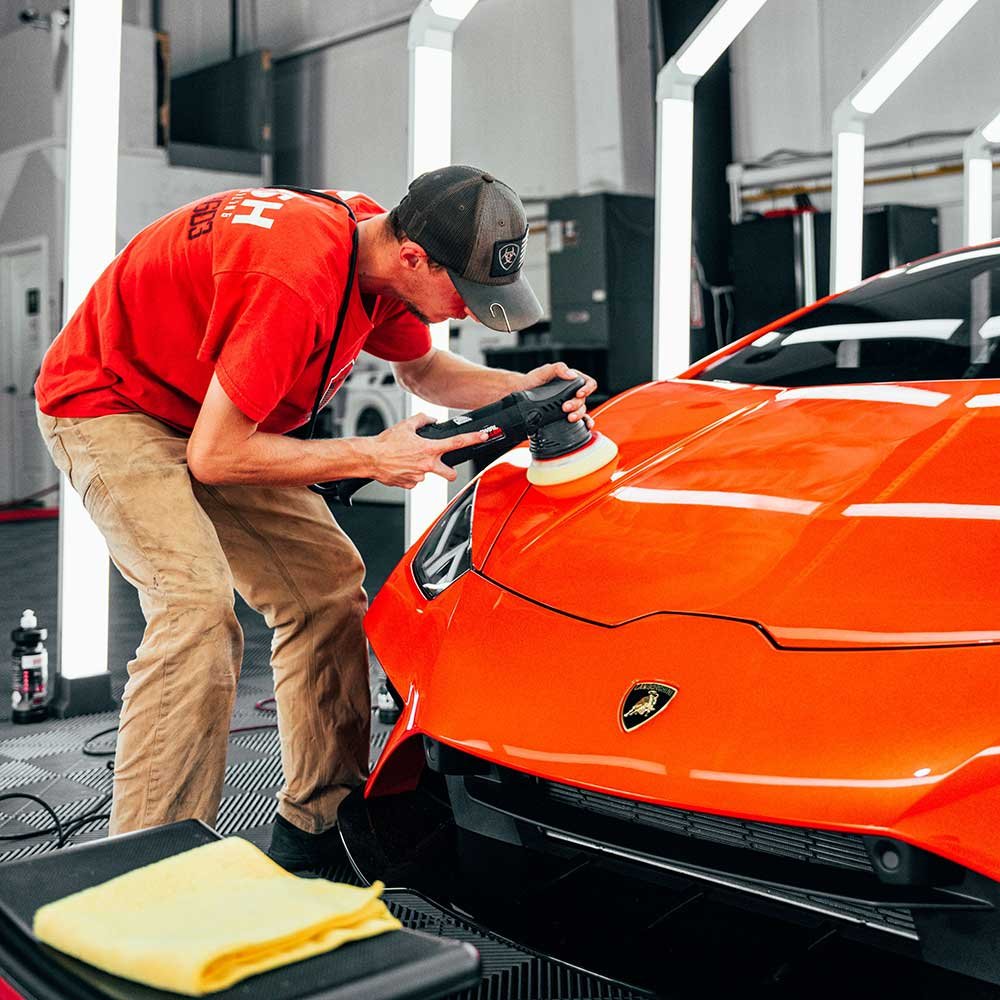

Ceramic Coatings can make a vehicle easier to wash, more resistant to common contamination, and noticeably glossier. But I want to set the right expectation from the start: a ceramic coating is a thin chemical protection layer, not armor. It will not stop a stone from chipping paint or erase existing swirl marks.
The best results come from matching the coating to the vehicle, correcting paint defects before installation when needed, and maintaining the surface after curing. That is where the value is.
Key Takeaways
• Ceramic coatings are thin liquid coatings that cure into a durable protective film on prepared automotive surfaces.
• Their most practical benefits are hydrophobic behavior, easier contamination removal, gloss, and resistance to UV exposure and common chemical contaminants.
• A coating does not make paint scratch proof or rock chip proof. Paint Protection Film is the stronger choice for impact protection.
• Surface preparation matters as much as the coating itself. A coating can preserve a polished finish, but it can also lock in visible defects.
• Water beading alone does not prove a coating is fully performing. Cleaning behavior, contamination resistance, and surface condition matter too.
Table of Contents
What Ceramic Coatings Are
• How the chemistry works
• Why hydrophobicity is only one performance signal
Choosing, Applying, and Maintaining a Coating
• Ceramic coating versus wax, sealants, and PPF
• Preparation, curing, maintenance, and common failure points
What Ceramic Coatings Actually Are
A thin film, not a thick physical barrier
Ceramic Coatings are generally liquid formulations applied in a very thin layer over automotive clear coat or another compatible surface. Many automotive products are marketed as silica or silicon dioxide, often written as SiO2, based. During the application process and cure period, the coating forms a bonded film that changes how the surface interacts with water, dirt, and chemical contamination.
The word ceramic can be confusing because it has a much broader meaning in materials science. Industrial ceramic coatings may be engineered for extreme heat, wear, electrical insulation, or specialized manufacturing environments. Automotive ceramic coatings are designed for appearance protection and easier maintenance under normal road and weather conditions. They are not the same thing as a thick thermal barrier coating on an engine component or an industrial wear coating.
What cross-linking changes on painted surfaces
As a coating cures, its chemistry cross-links into a more durable surface layer. In plain language, individual liquid components become part of a more interconnected film. That film can reduce the tendency of water, road film, bug residue, and other contaminants to cling directly to the clear coat.
Consider a vehicle parked under trees during pollen season. Unprotected paint can hold onto sticky pollen, sap residue, and airborne grime. A properly maintained coating may make those contaminants easier to remove during a safe wash, but it does not make them harmless if they sit on the vehicle for weeks.
Fair warning: “Harder” does not mean “scratch proof.” A thin coating can improve resistance to light marring and chemical attack, yet still be damaged by abrasive dirt, improper wash tools, or direct impact.
What laboratory standards can and cannot tell you
In technical ceramics, durability can be evaluated with specific test methods. For example, ISO 23114:2020 outlines an ambient-temperature bonding-strength test for ceramic coatings using compression testing on cross-joined test pieces.
Other standards address different properties. The ISO technical committee’s coating standards catalog includes methods related to scratch testing, film thickness, internal stress, and other coating measurements.
Those methods clarify an important point: durability is not one property. It includes adhesion, thickness, scratch behavior, chemical resistance, and the way a coating fails under stress. Consumer automotive coatings are not always marketed with directly comparable standardized test results, so broad claims such as “9H” should be treated carefully.
What Ceramic Coatings Protect Against
The benefits most owners notice
The day-to-day benefit is usually easier cleaning. Water tends to bead or sheet differently on a hydrophobic surface, and road grime may release more readily with proper wash chemistry and technique.
Ceramic Coatings may help reduce the impact of:
• UV exposure that contributes to oxidation and fading over time
• Road film, bug residue, bird droppings, tree sap, and industrial fallout
• Water spotting risk when mineral deposits are removed promptly
• Light wash-induced marring when careful washing is still used
• Dulling caused by contamination that remains on unprotected paint
The gloss improvement can be striking, especially after paint correction. The coating itself does not create perfect paint; it preserves and enhances the clarity of the surface underneath it.
What a coating cannot prevent
A ceramic coating is too thin to absorb meaningful impact energy from gravel, road debris, or a shopping cart strike. It also cannot stop a deep key scratch, prevent every swirl mark, or repair peeling clear coat.
| Threat or condition | What ceramic coating may do | What it cannot reliably do | Better option when needed |
|---|---|---|---|
| UV exposure | Add a protective layer that may help reduce oxidation | Reverse existing fading or clear-coat failure | Paint correction or refinishing, depending on damage |
| Bird droppings and sap | Make residue easier to remove when addressed promptly | Prevent etching if contamination remains too long | Prompt washing and spot treatment |
| Fine wash marring | Offer limited resistance to very light surface abrasion | Stop scratches from dirty towels or improper washing | Safe wash process and quality microfiber towels |
| Rock chips | Provide little meaningful impact protection | Prevent chips from gravel or road debris | Paint Protection Film |
| Deep scratches | Add minimal surface resistance | Stop a key scratch or heavy abrasion | PPF, touch-up, or refinishing |
| Existing swirl marks | Add gloss over corrected paint | Hide or remove defects already in clear coat | Paint correction before coating |
Hydrophobicity is useful, but incomplete
Water beading is highly visible, which is why it is often used to demonstrate a coating. Still, beading is not a complete durability test. A surface can bead water while carrying contamination, and a coating can appear to bead less when road film, mineral residue, or traffic film masks its surface behavior.
If water behavior becomes weak, I would not assume the coating has failed immediately. First, consider whether the surface needs a proper wash and decontamination. For example, a daily-driven vehicle parked outside near construction dust may develop a grimy film that reduces slickness and water behavior even when the underlying coating remains intact.
Ceramic Coating vs. Wax, Sealant, and PPF
Choose protection based on the threat
Wax, synthetic sealants, ceramic coatings, and Paint Protection Film solve different problems. The right choice depends on whether the priority is appearance, easier maintenance, impact protection, or a combination of those goals.
| Protection option | Primary strength | Typical limitation | Best fit |
|---|---|---|---|
| Wax | Warm appearance and simple application | Usually requires frequent reapplication | Owners who enjoy frequent hands-on maintenance |
| Synthetic sealant | Easy application and short-term protection | Less durable than many coating systems | Budget-conscious routine protection |
| Ceramic coating | Chemical resistance, gloss, hydrophobicity, easier cleaning | Does not stop rock chips or deep scratches | Vehicles where appearance and washability are priorities |
| Paint Protection Film | Physical barrier against many road impacts and chips | Higher cost and more visible edge considerations | Front ends, high-impact areas, performance vehicles, frequent highway driving |
| PPF with ceramic coating | Impact protection plus easier cleaning | Highest investment and installation complexity | Long-term ownership and high-value paint preservation |
When ceramic coating is worth considering
A coating is often a sensible choice when the paint is in good condition, the owner wants to reduce wash difficulty, and the vehicle will receive consistent maintenance. It can be especially useful on a new vehicle after inspection and correction of delivery-related defects, or on a well-kept vehicle after polishing restores paint clarity.
It may be less suitable when the expectation is zero maintenance or complete impact protection. If a vehicle spends most of its time on highways, follows gravel trucks, or sees frequent road debris, PPF on vulnerable areas may be the more practical first investment.
Spray coatings and professional coatings are not identical
DIY spray ceramic products can offer noticeable water behavior and short-term cleaning benefits. Professional-grade coating systems generally involve more demanding preparation, controlled application conditions, and longer cure requirements. Exact durability varies substantially by product, environment, prep quality, and maintenance, so generalized lifespan promises should be viewed as conditional rather than guaranteed.
| Factor | DIY spray ceramic product | Professional coating installation |
|---|---|---|
| Application difficulty | Usually lower | Higher; technique and environment matter more |
| Surface preparation | Often simplified | Typically extensive, including decontamination and polishing when needed |
| Cure sensitivity | Usually more forgiving | Can be sensitive to temperature, humidity, and timing |
| Failure risk | Uneven coverage or reduced durability | High spots, streaking, trapped defects, or cure issues if poorly installed |
| Expected service life | Often shorter and variable | May be longer, but depends on product and care |
| Best choice | Temporary enhancement or confident DIY maintenance | Long-term appearance protection with thorough prep |
The Application Process: Why Preparation Decides the Result
A coating preserves the surface it receives
Surface preparation is not a cosmetic extra. It is the foundation for bonding and appearance. Oils, traffic film, old wax, embedded fallout, and polishing residue can interfere with the coating’s ability to bond evenly.
A typical professional process may include:
- Thorough washing to remove loose dirt and road film.
- Chemical decontamination to address iron particles, tar, or other bonded contaminants.
- Mechanical decontamination where appropriate to create a smooth surface.
- Paint correction to reduce swirl marks, haze, oxidation, or other visible defects.
- Panel preparation to remove polishing oils and residues.
- Controlled coating application in small sections.
- Timed leveling to remove excess product before it cures into visible high spots.
- Protected curing before the vehicle is exposed to water, dirt, or harsh conditions.
Why high spots and streaking happen
A high spot is excess coating that was not leveled before curing. It may look like a darker patch, rainbow-like smear, greasy streak, or uneven gloss under bright lighting. Once fully cured, correcting it can require polishing and reapplication in that area.
This is one reason installation conditions matter. Temperature, humidity, panel temperature, product flash time, lighting, towel quality, and contamination control all influence the result. A coating applied in a dusty driveway on a humid day may face more variables than one installed in a clean, controlled studio environment.
Coating compatibility beyond painted panels
Ceramic products may be formulated for more than paint, including wheels, exterior trim, glass, PPF, and vinyl wraps. Compatibility is product-specific, so the surface and product instructions should be confirmed before application.
| Surface | Potential benefit | Important caution |
|---|---|---|
| Painted clear coat | Gloss, easier cleaning, contamination resistance | Correct paint defects before coating if appearance matters |
| Wheels | Easier brake-dust cleanup | Wheel temperatures and contamination require suitable products |
| Exterior plastic trim | Improved water behavior and appearance | Some trims may discolor or streak with incompatible products |
| Glass | Water behavior may improve | Wiper performance and product compatibility should be considered |
| Paint Protection Film | Easier cleaning and added surface slickness | Use a coating approved for film surfaces |
| Vinyl wrap | Reduced contamination adhesion | Confirm compatibility to avoid altering finish or appearance |
For a manufacturer-side reference on the same technical concept, Gtechniq’s ceramic-coating information points readers toward the ambient-temperature bond-strength testing described in ISO 23114:2020.
Maintaining Ceramic Coatings Without Wearing Them Down
Regular washing still matters
Ceramic Coatings reduce how strongly many contaminants stick, but they do not eliminate washing. Dirt still accumulates. Mineral-rich water can still leave deposits. Bird droppings and tree sap can still etch if ignored long enough.
A practical maintenance routine includes:
• Rinsing away loose debris before touching the paint
• Using a pH-neutral automotive shampoo when possible
• Washing with clean microfiber towels or mitts
• Drying with clean, dedicated microfiber towels or safe air-drying methods
• Removing bird droppings, sap, and bug residue promptly
• Avoiding harsh abrasive cleaners unless the coating manufacturer specifically permits them
Diagnose weak water behavior before replacing the coating
When beading fades, the issue may be surface contamination rather than complete coating failure. First wash the vehicle carefully. If needed, use a coating-safe decontamination process recommended for the specific product.
The distinction matters. Reapplying a coating over contamination or neglecting the underlying wash process can create a cycle where the vehicle looks briefly improved but remains difficult to maintain.
Make the maintenance decision practical
| Situation | Sensible next step | Why |
|---|---|---|
| Water beading is weaker but paint feels smooth | Perform a careful maintenance wash | Traffic film may be masking hydrophobic behavior |
| Paint feels rough after washing | Consider safe decontamination | Bonded contamination can reduce gloss and water behavior |
| Visible streaks appeared soon after installation | Seek assessment before aggressive cleaning | High spots may need correction rather than more product |
| New swirl marks appear | Review wash tools and technique | Coatings cannot compensate for abrasive washing |
| Frequent highway chip damage | Consider PPF on impact zones | Ceramic coatings are not designed for impact resistance |
Frequently Asked Questions About Ceramic Coatings
What is ceramic coating on a car?
Ceramic coating is a liquid protective coating that cures into a thin film on prepared automotive surfaces. It is primarily used to improve gloss, water behavior, cleaning ease, and resistance to common environmental contamination.
Is ceramic coating better than wax?
For longer-term chemical resistance and easier maintenance, ceramic coating is often the stronger option. Wax may still be preferable for owners who want a lower-cost product they can apply often and who enjoy regular hands-on detailing. Neither choice replaces safe washing or physical impact protection.
Is ceramic coating better than Paint Protection Film?
Neither is universally better because they protect against different threats. Ceramic coating is better for hydrophobic behavior, gloss, and easier cleaning. PPF is better for defending high-impact areas from many rock chips and road debris strikes. Combining PPF on vulnerable panels with a compatible coating is often the most comprehensive approach.
How long do Ceramic Coatings last?
Longevity varies by coating chemistry, preparation, application quality, storage conditions, driving environment, and maintenance. Some professionally installed systems are marketed for multiple years, while spray products may need more frequent reapplication. There is limited standardized consumer-level evidence that makes every brand’s lifespan claim directly comparable, so warranty language and maintenance requirements deserve close review.
Do Ceramic Coatings prevent scratches and rock chips?
No. They may offer limited resistance to very fine surface marring, but they do not reliably stop deep scratches, key marks, or rock chips. For impact protection, PPF is the more appropriate material.
Can ceramic coating be applied to glass, wheels, trim, wraps, or PPF?
Possibly, but only with a product formulated and approved for that surface. Wheel coatings need to tolerate high heat and brake dust. Glass coatings should be compatible with wiper use. Wrap and PPF coatings should be confirmed safe for the specific film type and finish.
Why is my coating no longer beading water?
Reduced beading may indicate contamination, mineral deposits, traffic film, or wear. Start with a careful wash and a coating-safe maintenance process before concluding that the coating has failed. Water behavior is useful evidence, but it is not the only measure of coating condition.
Can I apply ceramic coating myself?
Yes, especially with user-friendly spray products. A more durable coating requires careful preparation, clean conditions, precise timing, and proper leveling. DIY installation may make sense for a vehicle where temporary protection is acceptable. Professional installation is usually the safer choice when paint correction, controlled curing, or long-term cosmetic expectations are central to the decision.
The Smart Way to Choose Ceramic Coatings
Match the product to the vehicle and ownership plan
Ceramic Coatings make the most sense when the goal is to preserve a clean, glossy finish and simplify ongoing maintenance. They are particularly useful for vehicles that receive regular care and for owners who want stronger protection than wax without adding a physical film over every panel.
If the priority is stopping rock chips, start with PPF on high-impact areas. If the priority is correcting swirls and haze, address paint correction before coating. And if the priority is lower-cost, short-term water behavior, a quality spray coating may be enough.
A final decision framework
| Your priority | Best starting point |
|---|---|
| Easier washing and richer gloss | Ceramic coating after proper preparation |
| Rock-chip protection on front-facing panels | Paint Protection Film |
| Correcting dull paint or swirl marks | Paint correction before any protection product |
| Short-term, DIY-friendly protection | Spray ceramic product or sealant |
| Long-term appearance preservation | Professional correction, coating, and targeted PPF where needed |
A well-chosen coating should make vehicle care more manageable, not create unrealistic expectations. The best installation begins with an honest assessment of the paint, the way the vehicle is driven, and the kind of protection the owner actually needs.
Sources and References
• ISO — ISO 23114:2020: https://www.iso.org/standard/74595.html
• ISO/TC 206/WG 10 – Coatings: https://standards.iteh.ai/catalog/tc/iso/31672904-2ab7-46d8-b84a-009442ca10ca/iso-tc-206-wg-10
• gtechniq.com: https://gtechniq.com/product-category/auto/ceramic-coatings/